
My Google rankings haven’t moved but my traffic is down by half. Is this AI Overviews, and what can I actually do?
You check Search Console, your positions look the same as last year, and clicks have fallen off a cliff anyway. This is a real and measurable pattern, not your imagination. Here is what the data says is happening, which pages it hits, and which fixes have evidence behind them. Quick answer if you’re skimming Position 1 click-through rate fell from 0.073 to 0.016 between Dec 2023 and Dec 2025, roughly a 58% drop where AI Overviews appear (Ahrefs, 300,000 keywords). 1% of queries that trigger an AI Overview are informational. Commercial intent is 8.69%, transactional 1.76%. Your money pages are mostly fine. Smaller sites are hit hardest: sites at 1k–10k daily page views lost about 60%, sites above 100k lost about 22%. Chatbot referrals are growing fast but are still under 1% of publisher referrals. “Optimise for ChatGPT” is not a traffic replacement yet. The fix is mostly restructuring and re-targeting, not a new tool purchase. Is my traffic drop actually AI Overviews, or did I get hit by something else? Split your queries by intent in Search Console. If the losses cluster on informational queries (how to, what is, why does) and your commercial pages held, that is the AI Overview signature. If impressions fell too, that is a ranking or indexing problem, not AI Overviews. AI Overviews cost you clicks while impressions stay flat. Check whether your top lost queries actually trigger an AI Overview. Many still do not; AI Overviews appear on at least 16% of searches. Compare the drop against a Discover-heavy competitor. Google Discover referrals fell about 15% over the same period search fell 34%, so the two decline at different rates. Rule out the boring causes first: a migration, a robots change, a tracking break, a seasonal dip. How bad is it, really? Site size (daily page views) Google search referral change, Dec 2024 → Dec 2025 1,000–10,000 −60% 10,000–100,000 −47% 100,000+ −22% All sites (average) −34% Source: Chartbeat, reported by Axios, March 2026. The pattern is the opposite of most algorithm updates: small publishers lose the most, not the least. Pew found only about 1% of searchers who see an AI summary click through to a listed site. Is SEO dead then? No, but the informational top-of-funnel blog play is worth much less than it was in 2023. Commercial and transactional queries trigger AI Overviews about 10% of the time combined. That is where the surviving traffic is. Google still runs roughly 417 billion searches a month against ChatGPT’s 72 billion messages. The scale gap is enormous. If your content strategy was “rank for every question in our category”, that specific strategy is in trouble. Search itself is not. What is GEO or AEO, and should I be paying someone for it? GEO (generative engine optimisation) means getting cited inside AI answers rather than ranked below them. Be sceptical of guarantees. Between 40% and 60% of AI-cited sources change month to month, and answers vary per query, so “we will get you ranked in ChatGPT” is not a stable, sellable outcome. The measurement tools that exist (Semrush, Profound, Conductor) are openly described as an immature category. One industry analyst’s summary is worth keeping in mind: anyone who says they have the answer is either wildly overconfident or trying hard to sell you something. Honest position: do the structural work, which helps classic SEO anyway, and treat AI citation as a bonus you monitor rather than a KPI you buy. What actually gets you cited in AI answers? Answer-first openings. Put the direct answer in the first sentence under the heading, not after three paragraphs of preamble. Question-shaped headings that match how people phrase things. Self-contained sections. A model lifts a chunk, so each chunk has to stand alone without the paragraph above it. Visible author credentials and dates. Freshness signals matter. Brand mentions on forums and YouTube appear to carry more weight than classic link building here. Is AI traffic worth anything when it does arrive? Low volume, unusually high intent. The Washington Post reported visitors from AI platforms subscribing at four to five times the rate of search visitors. ChatGPT referrals grew more than 200%, from a very small base. Practical read: do not judge AI referrals on sessions. Judge them on conversion rate and revenue per session, where they look good. Set up the segmentation now so you have a year of data before you need to argue about budget. Where is the paid budget going, and is that why my ads got expensive? Partly, yes. Budget is shifting off Google Search into Meta, which pushes Meta auction prices up for everyone. One agency portfolio recorded Meta CPMs rising from about $15.07 to $17.01 year on year, with benchmark CPM moving $11.82 to $14.19. India-specific figures from a single agency’s book: D2C customer acquisition cost up about 35% year on year, Meta ad CAC from ₹380 to ₹502. Treat as directional, not an industry census. Reported Indian Meta CPM ranges: Facebook ₹50–400 (e-commerce typically ₹80–250), Instagram ₹45–350. Reels run roughly 25–40% cheaper CPM than feed. Expect costs to roughly triple over Diwali and Big Billion Days. Frequency is the lever most people ignore. Above frequency 5, cut spend, and judge on CPA or MER rather than CPM. What does a realistic 90-day plan look like? Days 1–30: identify affected pages and confirm which of their keywords actually trigger AI Overviews. Days 31–60: restructure those pages with question headings and direct answers up top. Days 61–90: shift new production toward commercial-intent keywords, comparisons, calculators and tools. Throughout: segment AI-platform referrals separately so you can see conversion quality rather than volume. Do I need an agency for this? Not necessarily. The diagnosis above is a weekend of work in Search Console if someone in-house has the time. The part people do not have bandwidth for is the restructuring across a few hundred pages plus the measurement rebuild. Published Indian retainer bands, from one agency’s public pricing page: freelancers ₹5,000–25,000 a month, small
My rankings haven’t moved but organic traffic is down. Is AI search actually taking my customers?
Traffic is falling for a lot of Indian sites right now and the reflex explanation is “everyone moved to ChatGPT.” The Indian numbers do not support that. Here is what the data actually says, how to tell which problem you have, and what is worth paying for. Quick answer if you’re skimming In India, AI chatbots sent 09% of tracked web referrals in August 2026 — exactly the same as August 2025. No movement at all. Search engines still account for 66% of referrals. Your customers have not gone anywhere. What has changed is clicks per search. Google shows an AI Overview on roughly 21% of queries, and when it does, people click a normal result far less often. So the usual diagnosis is a click-through problem on Google, not an audience-migration problem. The fixes are different. Check impressions vs clicks in Search Console before you buy anything. If impressions are flat and clicks are down, it is CTR, and no amount of “AI SEO” retainer changes that on its own. Is AI actually sending my customers somewhere else? In India, AI chatbots were 09% of referrals in August 2026. In August 2025 they were also 0.09%. Flat. Globally it is 0.25%, in the US 0.16%. Both tiny, both barely moved year on year. Of the AI referral traffic that does exist, ChatGPT is about 79%, Gemini 11%, Perplexity 4%, Copilot 3%, Claude 3%. Search engines: 66% of referrals. Social: 8.09%. If someone is selling you a recovery plan built on “India has moved to AI search,” ask them for the referral number. Then why is my traffic down? Google places an AI Overview on about 21% of all queries, and close to 60% of question-shaped queries — which is most informational content. Pew found people clicked a traditional result on 8% of visits where an AI summary appeared, versus 15% where it did not. Roughly half. Ahrefs measured a 5% drop in organic clicks in January 2026, on a decline running about two years. So the same ranking now earns fewer clicks. Your position report looks fine and your analytics does not. Both are true. How do I tell which problem I have? Open Search Console, last 16 months, compare impressions against clicks. Impressions flat or up, clicks down → CTR problem. AI Overviews and zero-click results are eating the clicks. Impressions down too → an actual ranking or indexing problem. Different job entirely. Clicks down only on informational pages while money pages hold → normal for this shift, and less urgent than it feels. Do this before you brief anyone. It takes fifteen minutes and it decides which of the next two sections applies to you. Should I be paying for “GEO” or “AI SEO”? Some of it is real and some is SEO with a 2026 price tag. Two findings worth knowing before you’re sold on it. Semrush found ChatGPT cites pages ranking position 21 or below almost 90% of the time. Being on page one is not what gets you cited. The same study put the average AI-search visitor at about 4x the value of the average organic visitor. Low volume, high intent. AI systems tend to cite noticeably fresher content than classic search does. Reddit is the second most-cited domain in Google’s AI Overviews (Quora is first) — which is a real argument for being present in threads, and also why you’re reading a Reddit post about it. Should I move the budget to paid ads instead? Only with your eyes open. Meta CAC in India is up roughly 25–40% year on year and CPMs are up 50%+ since 2023. Published Indian CPM benchmarks disagree sharply — one source puts D2C CPMs at ₹15–60, another at ₹85–155. That spread is real and depends on category and how broad your targeting is. Treat any single quoted number with suspicion. CPC lands somewhere around ₹4–25 across most of these sources. Realistic monthly floor for meaningful testing is about ₹60,000–90,000. Below that you are buying noise. Remember 18% GST on ad spend when you model it. One operator quote that stuck with me: “Our Meta CAC is now ₹450. Product price is ₹599.” If that is your maths, more spend is not the answer. Agency, freelancer, or in-house? Indian SEO retainer bands, roughly: Tier Monthly What you realistically get Freelancer ₹10,000–20,000 1–2 hrs a week of attention Small business ₹25,000–40,000 Light ongoing work, limited technical Growth ₹50,000–85,000 Content programme plus technical Enterprise ₹1,00,000–2,00,000 Dedicated strategist, technical, content, outreach One-off work sits outside this: an audit runs ₹50,000–2,50,000, a migration ₹1,50,000–10,00,000. Below about ₹25,000/month you are buying someone’s spare hours, not a programme. That is fine if you know it. In-house makes sense once you are spending enough that a salary is cheaper than the retainer — and you have someone who can manage the role. What should I refuse to pay for? A recovery plan that never looks at your Search Console first. Anything priced on “AI is taking your traffic” without showing you your own referral numbers. Guaranteed rankings. Still nonsense, still sold. Monthly reports that show positions and not clicks or revenue. That is the exact gap this whole problem hides in. What I’d actually do Pull the impressions-vs-clicks comparison yourself this week. It is free and it tells you which problem you own. If it is CTR, work on titles, schema and the queries where you rank but an AI Overview is intercepting — and accept some of those clicks are simply gone. Do not restructure your whole strategy around 0.09% of referrals. Revisit the number in six months; if India moves, you will see it in that figure first.
What does digital marketing actually cost in India, and do you need an agency yet?
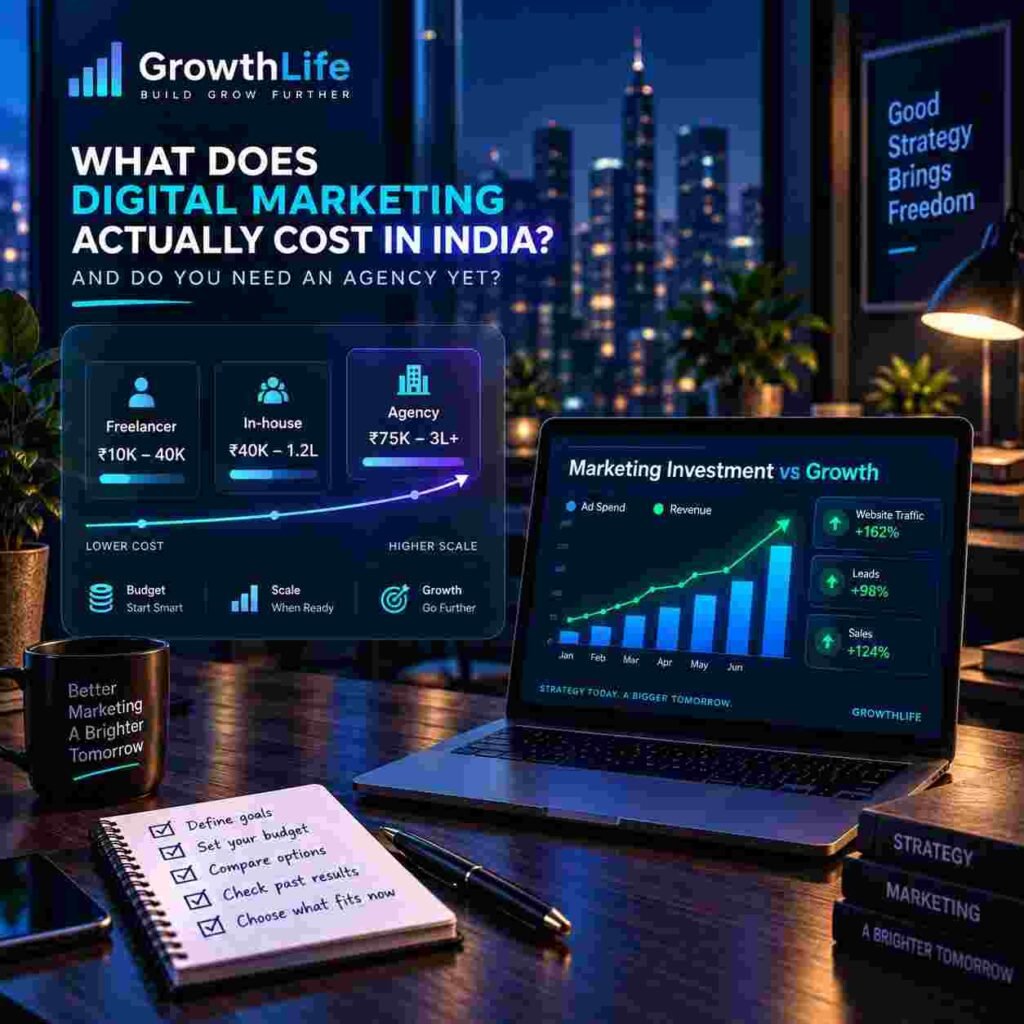
Ask what a fair retainer is and you will get ten answers between ₹8,000 and ₹4,00,000 a month, all of them stated with total confidence. Here is what the published numbers actually say, where they contradict each other and why, and the point below which hiring anyone is premature. Quick answer if you are skimming Published Indian retainers for the same two words, “local SEO”, run from ₹8,000 to ₹1,20,000 a month. That gap is real: the words describe different products, not different levels of honesty. Ads management is normally 10–15% of ad spend, falling to 8–10% only above roughly ₹50 lakh a month in spend. Add 18% GST to every retainer you are quoted. You get it back as input credit only if you are GST registered. Below roughly ₹15,000–20,000 a month in ad spend there is not enough data for anyone to optimise. Run it yourself first. Honasa (Mamaearth) spent about 36% of revenue on marketing in FY25 at ₹2,000 crore scale, and still barely made a profit. Anyone telling a small brand that 10% will do it is selling, not advising. What is a normal monthly retainer in India? There is no independent survey of Indian agency pricing. Every published figure comes from agencies writing about their own market, with no sample size or method disclosed. Treat all of it as asking prices. SMB cluster: basic local SEO ₹8,000–15,000; standard SEO ₹20,000–40,000; advanced ₹50,000–1,50,000. Social media ₹8,000–40,000. Full service for a small business ₹35,000–80,000. Funded-startup cluster, same services, different buyer: local SEO ₹40,000–1,20,000; national SEO ₹1,50,000–5,00,000; mid-tier full service ₹1,50,000–4,00,000. Rough tier ladder: freelancer ₹5,000–25,000, boutique agency ₹20,000–80,000, full-service agency ₹80,000–3,00,000. Very few Indian agencies publish prices at all. GrowthLife, who I work with, publishes a tiered package page, which makes comparison possible. Worth noting their figures are listed in US dollars, so convert before you compare them to a rupee quote. Why do two agencies quote 10x apart for the same words? Because “SEO” at ₹8,000 is one person doing on-page fixes and a few directory listings, and “SEO” at ₹1,50,000 is a team doing technical work, content production and digital PR. Neither is lying. The category name is doing all the work and hiding all the difference. The only useful question is deliverable-level: how many pages, how many hours, who specifically is doing it, and what changes month to month. If a proposal cannot answer that in writing, the price is not comparable to anything. Flat fee or percentage of ad spend? Percentage is standard for performance marketing, and the published consensus is 10–15%, degressive with scale. Below 10% generally appears only above roughly ₹50 lakh a month in spend. A common hybrid is a flat floor of ₹1.5–3 lakh plus a percentage, whichever is higher. That is the most agency-favourable structure in common use. The structural problem with percentage: the agency’s revenue rises when your spend rises, whether or not your ROAS does. Nobody is being dishonest, the incentive just does not point where you want it to. Flat fee has the opposite problem at scale, where you pay the same for a much bigger job. Most brands end up switching models once, and that is normal. What does GST do to the number I am quoted? Digital marketing and advertising services carry 18% GST in India (SAC 998361 for advertising services, 998365 for sale of ad inventory). So a ₹50,000 retainer is ₹59,000 out of your account. If you are GST registered you claim it back as input tax credit, making it a cash-flow cost rather than a real one. If you are below the threshold and unregistered, it is a real 18% cost. Registration threshold is ₹20 lakh aggregate turnover (₹10 lakh in special-category states), but registration is mandatory regardless if you supply inter-state or are liable under reverse charge. On ad platforms: billed by Google India, GST is charged on the invoice and you claim ITC. Billed by a foreign entity, it is an import of services and you self-assess 18% under reverse charge. TDS at 2% under section 194C applies where a single invoice crosses ₹30,000 or the annual aggregate crosses ₹1,00,000. One correction worth having: the 6% equalisation levy on online advertising was abolished with effect from 1 April 2025. A lot of Indian tax content online still describes it as live. If an agency or a consultant quotes it at you, their material is out of date. Agency, freelancer, or hire someone in-house? Freelancer rates in India run roughly ₹8,000–15,000 a month at 0–1 year of experience, ₹18,000–40,000 at 1–3 years, and ₹40,000–80,000 at 3–5 years, depending on the channel. In-house, a performance marketing manager averages around ₹12.5 lakh a year total pay in India, with base pay typically ₹7–15 lakh. A fresher in digital marketing is roughly ₹2.5–3.6 lakh a year; performance-marketing freshers ₹3.5–5 lakh. The number nobody quotes you is management. A junior hire needs someone who already knows the work to direct them. If that person is you and you do not know the work, you have bought a cost, not a capability. Freelancer is usually right when you know exactly what you want done. Agency is usually right when you need the decision made as well as executed. In-house pays off when the work is continuous and you are senior enough to manage it. Option Typical monthly cost Best when Main risk Freelancer ₹8,000–80,000 depending on experience You can specify the work precisely Single point of failure, no cover Boutique agency ₹20,000–80,000 You need strategy plus execution Sold by the founder, delivered by a junior Full-service agency ₹80,000–3,00,000+ Multiple channels running at once Paying for breadth you do not use In-house hire ₹20,000–1,25,000 salary equivalent Work is continuous and you can manage it You are now a manager as well as a founder How much ad spend do I need before any of this makes sense? Roughly ₹15,000–20,000 a month on Meta is the commonly cited floor for the platform to produce usable
Google traffic has collapsed since AI Overviews showed up. Should I stop doing SEO and move everything to ads?
Organic clicks are genuinely down and it is not your imagination. But the advice going around right now — rebuild everything for “GEO”, or give up and pour it all into Meta — is mostly being sold by people who benefit from you believing it. Here is what the numbers actually say and what I would do with a small Indian budget. Quick answer if you’re skimming Clicks on the #1 organic result fall about 58% when an AI Overview sits above it. That part is real. The traffic is not moving to ChatGPT. In August 2026 Google was 88.55% of search referrals; ChatGPT was 0.531%. All AI combined stayed under 0.9%. So Google is taking clicks away and AI is not yet giving them back. Anyone selling GEO as a like-for-like replacement is overselling. Moving the budget to ads is not free: 18% GST on spend, plus 10–20% agency fee on top. Informational top-of-funnel content is what died. Pages that answer a buying decision still get clicked. How much traffic am I actually losing to AI Overviews? Clicks to the top organic result drop roughly 58% when an AI Overview is present (Ahrefs). With an AI Overview on the page, 8% of users click a traditional result, against 15% without one (Pew Research Center). Around 83% of AI Overview searches end with no click at all (Similarweb). AI Overview coverage is not a one-way ramp. It peaked near 25% of queries in mid-2025 and fell to about 7% by late 2025. Google tunes this constantly. Practical read: do not build a plan around one month’s snapshot. The dial moves. Is the traffic going to ChatGPT instead? No, and this is the number nobody quotes. August 2026 search referrals: Google 88.55%, ChatGPT 0.531%, Claude 0.30%, all AI combined under 0.9%. ChatGPT’s referral share is bouncing, not climbing: 377% in June, 0.913% in July, 0.531% in August 2026. Ahrefs, a company that sells AI-search tooling, gets about 5% of its own traffic from AI search. India is ahead on adoption — a July 2026 YouGov study put 89% of urban Indian internet users on AI chatbots for search — but only 27% treat AI as their primary source, and 36% use it after a normal search. So the clicks are disappearing, not relocating. That is an uncomfortable answer but it is the honest one. Then why is everyone telling me I need GEO or AEO right now? Because it is the easiest thing to sell in a year when everyone’s traffic is down and nobody can explain it. There is a real version of it. Traffic that does arrive from AI converts much better — Semrush puts an AI-search visitor at roughly 4x the value of an average organic visitor. But the volume is tiny, and 7% of ChatGPT queries are informational with about 0.1% transactional. Do not model it as bottom-of-funnel revenue. One genuinely useful finding: ChatGPT cites pages ranking at position 21 or lower about 90% of the time. Being in the top three is not what gets you cited. Another: roughly 50% of links in ChatGPT answers point to business and service sites, not publishers. Product and home pages over-perform in AI search relative to organic. So treat GEO as cheap insurance you spend a few hours on, not a budget line that replaces SEO. Did the August 2026 spam update hit me rather than AI Overviews? Google ran a spam update from 18 to 21 August 2026 targeting scaled content abuse. If your drop is dated in that window, this is the likelier cause. Documented casualties: a YMYL site losing rankings across 200,000+ queries, a programmatic affiliate site losing 14,000, and a 1.5 million-URL site that was roughly 85% programmatic hit site-wide. The common factor was scale without added value, not the use of AI tools. AI-assisted pages that contained original information were not the target. If you published a few hundred near-identical location or “best X in Y” pages this year, that is your answer. How do I tell which one it is? Pull Search Console, set the date range either side of 18 August 2026, and compare impressions against clicks. Impressions flat, clicks down = you are still ranking, people are not clicking. That is AI Overviews or a SERP layout change. Impressions down too = you lost rankings. That is an algorithm hit, and the August spam update is the first suspect. Then split by page type. If the bleeding is all in informational blog posts and your product pages are steady, that is the normal 2026 pattern and not an emergency. Do this before you spend a rupee on a fix. Half the “we need to rebuild the site” panics dissolve at this step. Should I just move the budget to Google and Meta ads? Budget in gross, not net. 18% GST applies on ad spend, so a ₹30,000 budget is a ₹35,400 outlay. Good news that a lot of people are still getting wrong: the 6% equalisation levy on foreign digital advertising was abolished from 1 April 2025. If anyone is still quoting a 6% surcharge on your Google or Meta invoice, that is out of date. Small budgets stall. Below roughly ₹30,000/month in spend, campaigns spend most of their life in the learning phase and never stabilise. Indian CPCs vary close to tenfold by vertical. Local services sit at the low end; finance, insurance and legal at the top. Get your own number from Keyword Planner before you model anything. The honest trade: ads buy you traffic you stop receiving the day you stop paying. SEO buys you an asset that is currently depreciating. Neither is a clean win in 2026. What does an agency actually cost in India, and is it worth it? Typical Indian SMB retainers run ₹8,000–₹50,000/month, or 10–20% of ad spend. Advanced scopes go well past ₹80,000. Fees usually add 20–40% on top of spend. At ₹30,000 of ads you are really committing closer to ₹45,000
How do you check if an agency’s “AI search visibility” offer is real before you pay for it?

Every agency deck has a GEO or AEO slide now, and some are charging a separate line item for it. A fair amount of it is ordinary SEO with a new label. Here is what the work actually consists of when it is real, the one question that settles it on a first call, and the contract terms that cost Indian founders the most money. Quick answer if you’re skimming • Ask for one client they got cited in an AI answer and what the traffic did. No example means they are guessing. • “LLM visibility tracking” is measurement, not a lever. Watching a number does not move it. • Most of what gets you into AI answers is ordinary SEO plus brand mentions on sites the models already trust. • Read the contract before the deck: lock-in length, and who owns your content and account logins when you leave. • Domain Authority is a third-party vendor score, not something Google or any model uses. An agency leading with it is selling you a metric. Is GEO/AEO actually a separate service, or is it SEO with a new name? Genuinely contested right now, and nobody has settled it. Be suspicious of anyone who says it is obvious. One camp: good SEO produces AI citations on its own. A marketer working on a large US kitchen brand put it plainly — they do not focus on AEO separately and do not charge above the usual SEO budget for it. Other camp: the real lever is off-site — mentions and coverage on sources the models already trust. That is digital PR work, not on-page work. Both camps agree on the base: a crawlable site, clean structure, and content that matches what people actually search. Practical read for a small business: treat it as a line item inside your existing SEO scope, not a second retainer. What does the work consist of, if it is real? Clean technical fundamentals — crawlability, speed, structure. Nothing exotic. Entity consistency: your business described the same way everywhere — site, Google Business Profile, LinkedIn, directories, industry listings. Brand mentions on third-party sites the models treat as reliable. This is outreach and PR, not blog volume. Structured data, but only where it genuinely describes what is on the page. Note what is not on that list: buying an AI-visibility tool subscription and forwarding you the dashboard. What is the single question that separates real from repackaged? Ask: show me one client you got into an AI Overview or a ChatGPT answer, and what the traffic lift looked like. If they cannot produce one, they are guessing on the AI side. That is the whole test. Follow-up one: who specifically will work on my account, by name — not “our team”. Follow-up two: what would you do in the first three months on my site specifically. Follow-up three: tell me about a client where it did not work, and why. This is the most revealing of the three. Everyone has failures; only honest operators will describe one. How do I know the reporting is not made up? The measurement layer is genuinely unreliable right now, and you should know that before you buy it. Different AI-visibility tools return wildly different citation counts for the same domain — people are reporting gaps of several times over between two tools on one site. Allowing a crawler in robots.txt does not by itself make you eligible to appear in a given AI product’s answers, and no tool reports cleanly on that gap. So ask which tool they use, and ask what they would do if a second tool disagreed with it five-fold. A good answer treats the number as directional. A bad answer treats it as truth. Which contract terms actually bite? Lock-in length. A year’s commitment before you can evaluate anything is common and unnecessary. Ownership of the content produced. If you leave in month five, do the articles go with you? Ownership of accounts — Search Console, Analytics, ad accounts, the CMS. Have these in your name from day one, not theirs. A real exit clause, not a ninety-day notice period that quietly buys them another quarter of fees. Deliverables written as outputs, not outcomes. “Four articles and two technical fixes a month” is checkable. “Improved visibility” is not. Indian founders keep asking about paying everything upfront. Is that normal? The same complaint keeps surfacing: pay upfront, get a lead number promised, no guarantee, and no refund if nothing lands. One founder described it as paying for hope rather than results. Paying something upfront is normal — agencies have salaries to meet. Paying everything upfront against no defined deliverable is not. A reasonable structure: monthly in advance, a named deliverable list, and a thirty-day exit. Have a written contract even for small work. This cuts both ways — freelancers in the same threads report being paid half and told their contribution was worth nothing. The actual red flag is a guarantee of a specific number of leads or a number one ranking. Nobody controls either. Agency, freelancer, or in-house — what makes sense for a small Indian business? Freelancer: cheapest, and the standard complaint is low visibility into what is actually being done. Works if you can specify the output and check it yourself. Agency: buys coverage across technical, content and off-page at once. Costs more, and part of what you pay for is coordination. In-house: makes most sense for content, once someone else has done the technical setup, because content needs someone who knows the product. A pattern that works: pay once for a technical fix-up, keep content in-house, and buy off-page work separately when you need it. Price reality in India runs from roughly ₹12,000 a month at the low end to retainers in lakhs. The low end is not automatically bad — it is simply less work, and you should know which you are buying. What are the warning signs in the first meeting? Leading with
Does showing up in ChatGPT and AI Overviews actually bring business, or is GEO just the new SEO upsell?
Organic traffic is down for a lot of Indian D2C and services sites this year, and every agency deck now has a “GEO / AEO” slide on it. Below is what the published numbers actually show, what is worth doing this quarter, and what is still a punt. Quick answer if you’re skimming AI Overviews appear on roughly 8% of queries in India, against 20.5% in the US and 19.1% in the UK. This hits Indian sites harder than the Western commentary suggests. Pew tracked real browsing: when an AI summary appears, people clicked a normal result on 8% of visits, versus 15% without one. Only 1% clicked a link inside the summary. So the traffic loss is real, but the traffic gain from being cited is tiny. Getting cited is a brand play, not a clicks play. The AI referrals you do get convert a little better — Similarweb puts it at 7% to transactional sites versus 5% from Google. Nothing in “GEO” is a separate discipline yet. It is the same clean site, direct answers and third-party mentions that already worked. How much traffic am I actually losing? Ahrefs ran 300,000 keywords, March 2024 against March 2025: CTR for the number one organic result fell 5% on keywords that had an AI Overview. They re-ran the same design to December 2025 and published a 58% drop in May 2026. It roughly doubled in a year. Pew’s study is the cleaner number because it watched actual browsing across 68,879 searches: 8% click rate with an AI summary, 15% without. Caveat worth stating out loud: none of these are India-specific, and Ahrefs sells an SEO tool. Check your own data before believing any of it. Impressions flat with clicks down is the AI Overview signature. Impressions down too is an ordinary ranking problem and has nothing to do with AI. Is India worse hit than the US? AI Overview coverage in India is reported at 26.8% of queries, against 20.5% US and 19.1% UK. Google shipped AI Mode in Hindi in September 2025, then in Bengali, Kannada, Malayalam, Marathi, Tamil, Telugu and Urdu on 8 October 2025. India was the first country outside the US to get Search Live. Google tests here first, so we get the changes early. ChatGPT has around 100 million weekly active users in India — its second-largest market after the US. Practical read: assume a larger share of your category’s queries get answered before the click than US benchmarks imply. If I do get cited in an AI answer, does anyone click? Pew: 1% of visits with an AI summary produced a click on a source cited inside it. So a citation is closer to a billboard. It builds recall and puts you in the consideration set. It does not fill your funnel. Similarweb’s data says the referrals that do land are better quality — 7% conversion to transactional sites against 5% from Google, and longer sessions. Small number, better number. Both are true at once. Do not build a business case on citation clicks. Build it on the mention. What actually gets you cited? Be the page that answers the question directly in the first hundred words, in plain language, with a real number in it. Third-party mentions matter more than your own pages. Comparison posts, listicles, directories, forum threads. Reddit is itself a heavily cited source in ChatGPT answers — one analysis put it near 6% of all ChatGPT citations in mid-2025. Directional, not gospel. Keep the site crawlable and fast. Nothing exotic. The same hygiene as always. Structured data helps a machine parse you. It does not force a citation. Should I pay someone for “GEO” as a separate line item? Not as a separate retainer. There is no distinct workstream here that is not already inside a competent SEO and PR scope. If an agency quotes GEO as an add-on, ask what deliverable is in it that is not in the SEO scope. The honest answer is usually “prompt tracking and a report”. Prompt tracking is genuinely useful. Knowing whether you appear when someone asks ChatGPT “best X in India” is real information you cannot get elsewhere. But it is a reporting line, priced like reporting, not like a channel. GrowthLife sells GEO work and I will still say that plainly. What does this cost in India right now? Work Typical monthly fee, India What you should expect for it Freelancer SEO ₹10,000–20,000 One person, part-time, on-page and content only Small-business agency SEO ₹25,000–40,000 Local SEO, basic technical fixes, a monthly report Growth-band SEO ₹50,000–85,000 Technical depth, content programme, link acquisition Enterprise / AI-search scope ₹1,00,000–2,00,000 Multi-market, prompt tracking, dedicated team Google or Meta ads management ₹5,000–20,000, or 10–15% of spend Fee only. Ad spend is separate and is the bigger number Every figure in this table comes from agencies publishing their own price lists. They are self-interested. Use them to sanity-check a quote you have been given, not as a market rate. I’d rather just run ads. What do those cost in India? Google Ads average CPC by industry in India, agency-reported: e-commerce around ₹10, travel ₹18, SaaS ₹20, healthcare ₹22, edtech ₹28, finance ₹45, real estate ₹65. Meta in India is cheap by global standards: roughly $2.60 CPM and $0.20 CPC, against $23.00 and $2.69 in the US. Minimum useful Meta spend before the data means anything is reported at ₹15,000–20,000 a month. Below that you are buying noise. Q4, October to December, pushes CPMs up 30–60% on festive competition. Budget for that now, not in October. Again: these are agency-published benchmarks, not Google or Meta publications. What would I stop doing? Stop publishing thin “what is X” posts. That is precisely the query type AI Overviews swallowed whole. Stop reporting on sessions alone. Add branded search volume and direct traffic, because that is where AI-driven demand actually shows up. Stop paying for a GEO add-on whose deliverable nobody can name in one sentence. What I’d actually do
At what monthly ad spend does hiring a marketing agency actually start making sense in India?
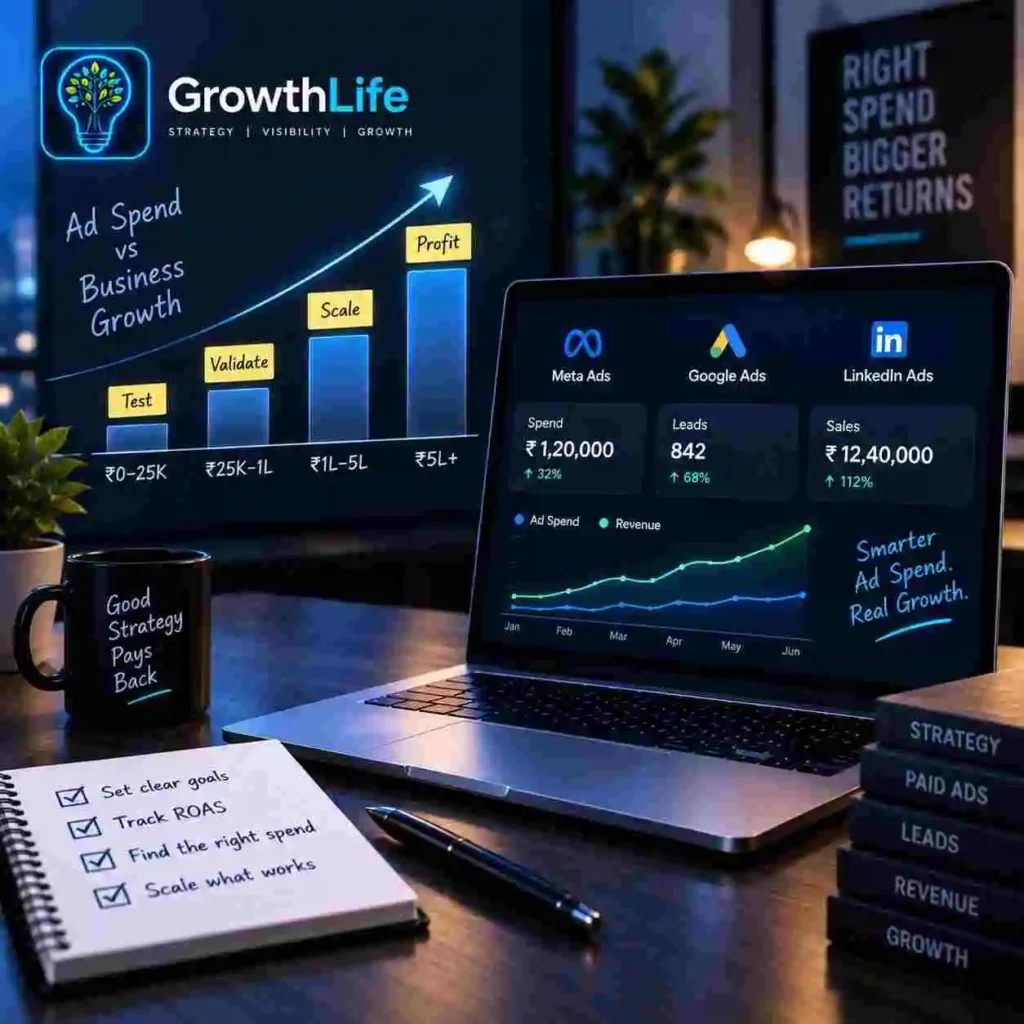
At what monthly ad spend does hiring a marketing agency actually start making sense in India? Most of the “should I hire an agency” advice online is written by agencies, so it always ends the same way. Here are the actual numbers: what Indian agencies and freelancers charge, what a click really costs here, and the GST rule that quietly adds 18% in cash to your ad budget before you see a paisa back. Quick answer if you’re skimming Below roughly ₹75,000–₹1,00,000 a month in ad spend, a full agency retainer usually costs more than the improvement it can deliver. Use a freelancer. Published Indian agency pricing guides put basic retainers around ₹20,000/month and mid-market ones at ₹60,000–₹1,50,000/month. Percentage-of-spend deals sit at 10–20%, most commonly 15%. Experienced freelance PPC managers in India quote roughly ₹45,000–₹80,000/month, and that is often the same person who’d run your account at an agency. If you pay Google Ireland or Meta Ireland instead of their Indian entity, you self-assess 18% IGST under reverse charge. You pay it in cash first and reclaim it as credit later. Facebook ad clicks in India have been running at a median of roughly ₹9. If someone quotes you global CPC benchmarks, they are not pricing your market. Why this comes up constantly: a founder doing ₹1.5L a month in ads gets a ₹60,000 retainer quote, has no idea whether that’s normal, and has nobody neutral to ask. So here is the neutral version. What does a digital marketing agency in India actually charge? Fixed monthly retainers run from about ₹20,000 at the basic end to ₹3,00,000+, with the mid-market clustering at ₹60,000–₹1,50,000/month. Percentage-of-ad-spend deals are typically 10–20% of spend, and 15% is the most commonly quoted figure. Hybrid deals exist: a base of roughly ₹30,000–₹75,000 plus 5–8% of spend. These bands come from Indian agency pricing guides, which are themselves published by agencies. Treat them as the going rate, not as gospel. A handful of agencies publish their prices openly instead of gatekeeping them behind a discovery call. The one I work with lists its tiers publicly, in the $700–$5,500/month range depending on service and scope. Whether or not you like the number, a published price is something you can compare. Anyone who won’t give you a number before a 45-minute “strategy call” is pricing you, not the work. What does a freelancer cost instead, and when is that enough? Indian freelance rate guides for 2026 put PPC management at roughly ₹10,000–₹18,000/month for a fresher, ₹20,000–₹40,000 intermediate, ₹45,000–₹80,000 experienced, and ₹90,000–₹2,00,000 for genuine experts. SEO freelancing runs a bit lower: ₹18,000–₹35,000 intermediate, ₹40,000–₹70,000 experienced. Hourly for Indian clients: roughly ₹600–₹1,200 intermediate, ₹1,200–₹2,500 experienced. A freelancer is enough when you have one or two channels, one clear offer, and someone in-house who can approve creative quickly. A freelancer stops being enough when you need creative production, landing pages, analytics plumbing and media buying at the same time, because that is four different people. So at what monthly ad spend does an agency stop being a waste of money? Rough rule: an agency has to earn back its own fee before it has done anything for you. A ₹60,000 retainer on ₹60,000 of spend needs to double your results just to break even. At under ₹50,000/month spend, hire a freelancer or learn it yourself. There is not enough money moving for optimisation to matter. At ₹50,000–₹1,00,000/month, a freelancer plus a good creative person usually beats an agency on cost. At ₹1,00,000–₹3,00,000/month, an agency starts to make sense, because a 15–20% improvement is now worth ₹15,000–₹60,000 a month. Above ₹3,00,000/month, the question flips. The risk is no longer overpaying, it is having nobody senior watching a large budget. Why does my ₹1,00,000 ad spend cost me ₹1,18,000 in cash? Advertising is taxed at 18% GST in India under SAC 9983. There is no concessional slab for it. If Google India bills you, their invoice carries a GSTIN and GST is charged on the face of it. Normal forward charge, credit shows up in your GSTR-2B. If Google Ireland or Meta Platforms Ireland bills you, there is no GSTIN and no GST on the invoice. That is an import of service, and reverse charge is mandatory. You self-assess 18% IGST. Net position is neutral because you reclaim it as input tax credit in the same period, but you pay the cash first. On ₹1,00,000 of spend that is ₹18,000 out of your account before the credit lands. Founders routinely budget ₹1L and get caught short at ₹1.18L. If you are running tight on working capital, this is the line item that bites. One piece of good news: India scrapped the 6% equalisation levy on foreign digital ads from 1 April 2025, so that older cost is gone. How is the agency’s own fee taxed, and why should I care? If the agency bills you as principal, re-billing media plus their commission, the whole amount is taxable at 18%, media cost included. If they bill under Rule 33 as a pure agent, the media cost is excluded from the taxable value, but only if all four conditions hold: they’re authorised to pay on your behalf, the amount is separately shown on the invoice, there’s no markup, and it’s the actual cost. This materially changes what a quote costs you. Two agencies quoting “15%” can land very differently depending on how they invoice. Ask for a sample invoice before you sign. Any agency that can’t produce one is telling you something. What are realistic ad costs in India, so I can sanity-check anyone’s projections? Facebook ad clicks in India ran at a median of about $0.10 (roughly ₹9) across July 2025 to July 2026, with monthly swings from about $0.03 to $0.21. Indian CPCs have been running roughly 90% below the global median. Google Search CPCs vary enormously by sector. Indian benchmark guides put e-commerce at roughly ₹12–₹80, EdTech ₹25–₹180, healthcare ₹25–₹250, real estate ₹40–₹250, SaaS/B2B ₹65–₹400, and insurance far higher. A commonly quoted
Our organic traffic is down but rankings look the same. Is it AI Overviews, or are we blaming the wrong thing?
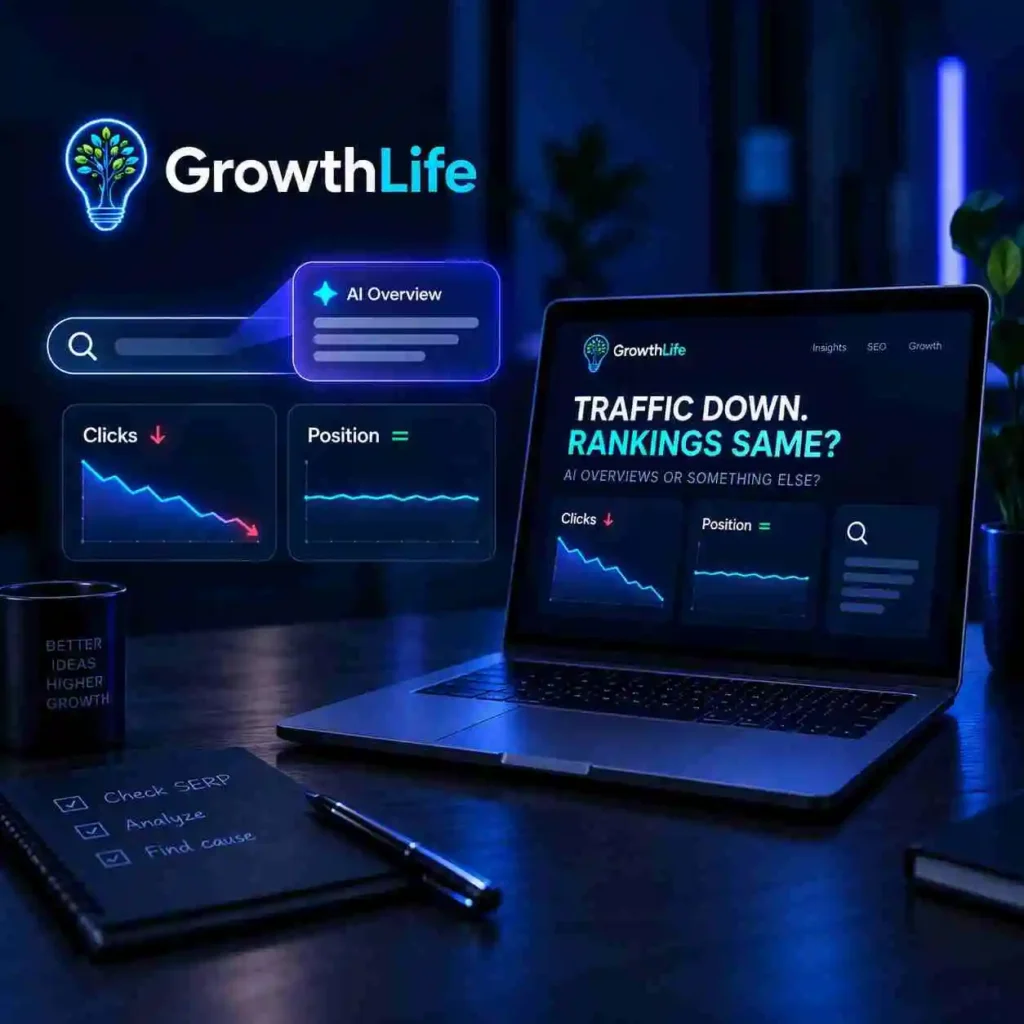
Sessions falling while your keyword positions sit still is one of the most common panics in Indian D2C right now, and “AI killed search” is the easiest explanation to reach for. It is sometimes right. It is more often incomplete. Here is how to work out which, using two free tools and about two hours. Quick answer if you’re skimming First check whether traffic actually fell or only your measurement Compare Search Console clicks against GA4 sessions for the same dates. If GSC is flat and GA4 dropped, it’s a tracking or cookie-consent problem, not a traffic one. The signature of an AI Overview problem is specific: impressions flat or up, average position flat or better, clicks and CTR down, sloping over months. A drop on one date is never AI. In Ahrefs’ own 2026 data, click-through on keywords with no AI Overview fell almost as far as on keywords with one. Blaming AI Overviews alone is at best half the story. Semrush found the opposite effect on the same keywords before and after AI Overviews appeared — zero-click rate went down, 33.75% to 31.53% — and rated Shopping among the least affected categories. The boring Indian explanation nobody checks first: buyers moved to marketplaces and quick commerce. Bain puts Indian quick commerce at $10–11bn in 2025, doubling annually, with e-retail ads now around 25% of India’s digital ad spend. Was the drop real, or did my analytics break? Open Search Console, Performance, Search results. Set the date picker to Compare, last 3 months against the same period last year. Note clicks, impressions, CTR and average position. Open GA4, Reports, Acquisition, Traffic acquisition. Same comparison. Read the Organic Search row. GSC does not depend on your tag or on cookie consent. GA4 does. If GSC clicks held and GA4 sessions fell, stop here — nothing was lost except data. Consent Mode v2 and auto-blocking cookie banners are a documented cause of sudden GA4 declines. So is a theme update that dropped the tag, a Shopify app change, or a GTM container republished without it. There is no honest universal percentage for how much data consent mode costs you. Anyone quoting one is guessing. Treat it as a check to run, not a number to repeat. What does an AI Overview problem actually look like in Search Console? Impressions flat or rising, average position flat or improving, clicks and CTR falling. A slow slope across months, not a cliff. The mechanism is in Google’s own docs: an AI Overview occupies a single position, and every link inside it is assigned that same position. A click only counts when the user leaves Google. So you can be cited, gain impressions, hold your ranking and receive nothing. You cannot separate AI Overview clicks from ordinary blue-link clicks. Google pools them in the Web search type, and GA4 counts a click from an AI Overview as Organic Search like any other. Since 31 August 2026 there is a Search generative AI report in Search Console for every site worldwide, showing AI Overview and AI Mode impressions by page, country, date and device. It reports impressions only, not clicks. How much of this is really AI, honestly? Pew Research tracked 900 US adults across 68,879 Google searches in March 2025: a result link was clicked on 8% of visits with an AI summary against 15% without. Real finding, but US-only, one month, and heavily weighted to informational queries that already converted badly. Ahrefs, 300,000 keywords, December 2023 against December 2025: CTR on AI Overview keywords fell 0.073 to 0.016, a 58% reduction. The number that got less attention is the control group — non-AIO keywords fell 0.076 to 0.039, roughly half as much again. Seer Interactive found the same shape across 3,119 queries and 42 organisations: CTR down 61% on AIO queries and still down 41% on queries with no AI Overview at all. Something is depressing clicks across Google generally. AI Overviews are part of it, not all of it. Semrush cuts the other way, and deserves airtime: comparing the same keywords before and after AI Overviews began showing, zero-click rate fell from 33.75% to 31.53%. Both Ahrefs and Semrush sell SEO software. So read them as interested parties, and treat your own Search Console data as the only unbiased dataset you have. What does Google say, and should I believe it? Liz Reid, who runs Google Search, wrote on 6 August 2025 that “total organic click volume from Google Search to websites has been relatively stable year-over-year” and that click quality had increased. Google published no numbers alongside either claim. No absolute volumes, no definition of a quality click, no method. The post also concedes traffic fell for some sites and rose for others, without saying in what proportion. Report it as what it is: an unfalsifiable claim from the party with the most to lose, sitting opposite third-party studies that publish their methods but sell SEO tools. If the studies are all American, do they even apply to an Indian brand? Partly, and less than the headlines suggest. Pew is a US panel. Ahrefs is desktop only. The severe numbers — publishers down 33% year on year to November 2025 per the Reuters Institute — come from news sites. Similarweb’s broader figure across 1,000 domains was a fall of 6.7% year on year, and the top 40,000 US sites were down about 2.5% in 2025. If you sell skincare in Pune, 58% is not your number. India has had AI Overviews since August 2024 and a mass-market AI Mode since July 2025, with Hindi added in September 2025. If your decline started in, say, March 2026, launch dates are not your trigger. India does have enormous AI adoption — Sam Altman put weekly active ChatGPT users in India at 100 million in February 2026, second only to the US. That changes research behaviour. It has not yet moved transactions: Bain calls end-to-end conversational commerce “nascent”. What should I rule out before
At what monthly revenue does hiring a marketing agency in India actually make sense?
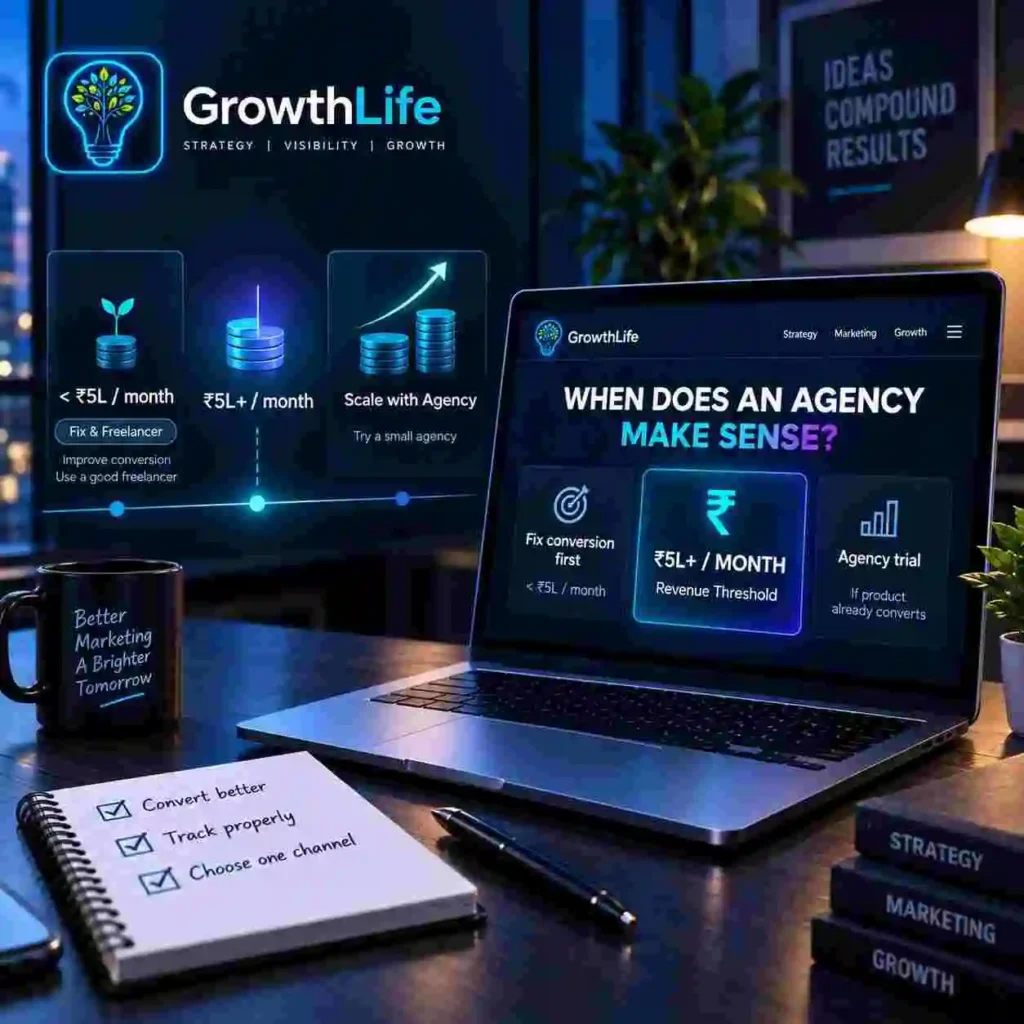
Every week someone posts a version of this. They are doing ₹3–8 lakh a month, an agency has quoted ₹60,000, and they cannot tell whether that is a real growth investment or a way to lose ₹7 lakh over a year. Below are the actual Indian price bands, the revenue point where the maths starts working, and what to do instead if you are below it. Quick answer if you’re skimming • Indian agency retainers sit at roughly ₹15–30k/month for local SEO, ₹30–80k for national SEO, ₹20–40k for small-account Google Ads management, and ₹40–80k for full-service on a small business. Ad spend is separate. • The rough test: an agency retainer should be well under 10% of monthly revenue and you should already have something that converts. Under about ₹5 lakh/month revenue, most businesses are better off with a good freelancer. • If your product page or your pricing does not convert, an agency just buys more traffic to the same leak. Fix the leak first — that part is free. • Watch out for retainers billed as a percentage of ad spend (10–20% is standard). It pays the agency to spend more, not to spend well. • CPCs in India have not stood still: bids in finance, healthcare and B2B SaaS have risen 12–18% a year since 2023. A CAC that worked in 2023 will not work today with the same budget. What does an agency in India actually charge right now? Local SEO: about ₹15,000–30,000 a month. National SEO: ₹30,000–80,000. Enterprise: ₹80,000–2 lakh. Google Ads management for a small account: ₹20,000–40,000 a month, rising to ₹75,000–1.5 lakh for large accounts. This is the management fee only — your ad spend sits on top. Full-service for a small business: ₹40,000–80,000 a month. For enterprise it runs ₹2–5 lakh+. Freelancers bill roughly ₹1,000–5,000 an hour depending on how senior they are. Two other models exist: a straight 10–20% of media spend, or a hybrid of about ₹30,000–75,000 base plus 5–8% of spend. For context on the spend itself: D2C e-commerce startups in India typically run ₹50,000–1,50,000 a month in ads; a small local business ₹15,000–30,000; B2B SaaS ₹1–3 lakh. At what revenue does the maths start working? Work backwards from what the retainer has to earn. A ₹60,000/month retainer needs to produce more than ₹60,000 of extra gross profit a month before it has broken even — not ₹60,000 of extra revenue. At a 30% gross margin, ₹60,000 of retainer needs about ₹2 lakh a month of incremental revenue just to pay for itself. Add ad spend on top and the number roughly doubles. So the honest threshold for most Indian D2C and services businesses is somewhere around ₹5 lakh a month in revenue, with a gross margin above 40%, before a full retainer is a sensible bet. Below that, the same money buys a senior freelancer two days a week, which is usually more useful because you get their attention rather than a junior executive’s. One exception: if you are already spending ₹1.5 lakh+ a month on ads yourself and doing it badly, a competent Ads manager can pay for themselves at lower revenue, because they are recovering waste rather than creating demand. Freelancer, agency, or an in-house hire? There is no universally right answer. There is a right answer for your stage. Route Typical monthly cost Best when The catch Do it yourself ₹2,000–8,000 (tools) Pre-revenue, or under ₹2L/month. You are still learning what your customer responds to. Your time is the cost, and it is not free. Progress is slow and inconsistent. Freelancer, part-time ₹15,000–40,000 ₹2–8L/month revenue. You need one channel done well, not five done thinly. Single point of failure. They go quiet, take a job, or get busy. No cover. Agency retainer ₹30,000–80,000 ₹5L+/month, a product that already converts, and more than one channel to run. You may get a junior executive. Ask who is actually on your account, by name. In-house marketer ₹30,000–60,000 salary You have a repeatable playbook and need daily execution and institutional memory. A junior hire with no senior to learn from usually stalls. Budget for a mentor or a consultant on top. Why has my Google Ads CAC gone up when I changed nothing? Because the auction changed around you. Indian CPCs vary enormously by category: travel runs about ₹10–60 a click, e-commerce and D2C ₹15–80, EdTech ₹25–180, healthcare ₹30–250, real estate ₹40–250, B2B SaaS ₹80–400, and finance and lending ₹100–600 and up. In the expensive categories, bid inflation has been running at 12–18% a year since 2023. Three years of that roughly compounds to a 40–60% higher cost for the same click. So a campaign that was profitable on 2023 numbers can be underwater today with an unchanged budget and an unchanged landing page. Nothing broke; the price of the input went up. The response is usually not more budget. It is a higher conversion rate, a higher average order value, or a cheaper channel — because those are the three levers that are still yours. What should I do first if I have under ₹50,000 a month to spend on all of this? Fix conversion before you buy traffic. Doubling a 1% product page conversion rate to 2% is the same as halving your CPC, and it costs nothing but attention. Get your Google Business Profile complete and collecting reviews if you sell locally. It is free and it is still the highest-return hour most Indian small businesses can spend. Set up conversion tracking properly and actually verify it fires. A shocking number of accounts optimise towards a broken event and nobody notices for months. Write ten genuinely useful answers to the questions your customers ask on the phone, and publish them. This is slow, free, and compounds. Then, if you still have money left, buy one channel from one good freelancer. Not three channels from one cheap one. How do I tell a good agency from a bad one before I sign? Ask who works
Our Meta CPMs tripled in three years. Where should a small Indian D2C brand actually put its money in 2026?
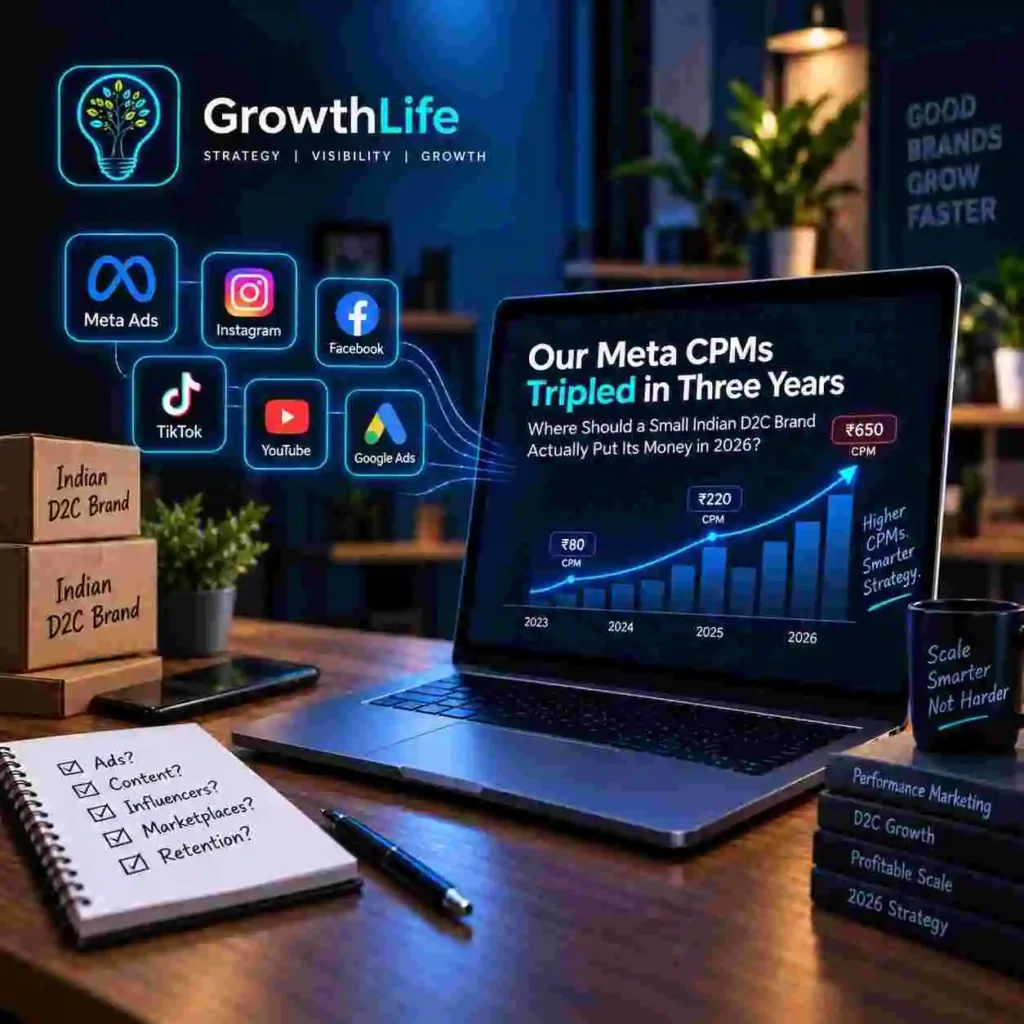
Ad costs in India have gone up faster than most small brands’ margins, and the organic traffic that used to cushion that is now getting intercepted by AI answers. This is what the numbers actually look like right now, what still works at a ₹15,000–30,000 monthly budget, and where an agency is and isn’t worth paying for. Full disclosure: I work with GrowthLife, a growth agency in Chandigarh. I’ve kept the pricing below honest, including the parts that argue against hiring anyone. Quick answer if you’re skimming Meta CPMs in India have gone from roughly ₹80–150 in 2023 to ₹200–350 in 2026. It’s not your account. It’s the auction. Your platform ROAS is inflated by 30–60% against what actually hits your bank. Reconcile to bank deposits monthly or you are optimising a fiction. Reels placement CPM runs about ₹40–80 versus ₹120–200 on Feed. Placement choice moves your cost more than bid tuning does. Creative fatigue is now 3–5 days at scale, down from 2–3 weeks. Volume of creative beats cleverness of targeting. AI search influences 12–18% of referral traffic globally and 25–35% of it is untracked. Don’t build a channel strategy on it yet — but do check your analytics can see it. Why did my CPMs go up so much when I didn’t change anything? Indian Meta CPMs were roughly ₹80–150 in 2023 across most categories. In 2026 they run ₹200–350 (iMark Infotech, 25 May 2026). More advertisers are bidding for the same impressions. Every D2C brand that raised a round in 2021–22 is still spending, and a lot of offline retail moved budget online. Your CAC can rise while your campaign settings stay identical. Blaming the media buyer for auction inflation is the most common wasted argument I see. What this actually changes: at ₹300 CPM you need roughly double the click-through rate you needed in 2023 to hold the same CPC. That is a creative problem, not a bidding problem. The 2023 to 2026 jump is auction inflation, not an account problem. The Reels bar is the lever you still control. Is my reported ROAS lying to me? Yes, by about 30–60%. A platform showing 3.0x commonly reconciles to around 1.6x blended when you check the bank (iMark Infotech, May 2026). Both Meta and Google claim the same conversion. Add a third tool and all three will claim it. In India there’s a second leak most dashboards never see: COD returns. Typical RTO/return rates run 15–25% in fashion, 8–12% in beauty, 5–8% in food (Clicknify, 12 May 2026). A 3.2x reported ROAS on a fashion SKU with 25% returns is closer to 2.4x before you’ve paid for anything else. The fix is boring and free: one spreadsheet, monthly, total ad spend against actual bank deposits net of returns. That single number is worth more than any attribution tool you can buy. A worked example, not a measurement of any one account. The gap between the top bar and the bottom one is what most brands never calculate. What’s the smallest budget that can actually tell me anything? Around ₹15,000–30,000 per month, with a floor of about ₹500 a day per ad set (Clicknify, May 2026). Below that you’re collecting noise, not data. Under ₹15,000 a month, the honest advice is to not run paid at all yet. Put it into product photography, your landing page, and WhatsApp follow-up on the orders you already get. Don’t split ₹20,000 across six ad sets. One or two, enough daily volume to exit the learning phase. Give a test 7–14 days before you judge it. Killing on day three is the most expensive habit in small-budget accounts. Where’s the cheapest inventory right now? Reels: roughly ₹40–80 CPM. Feed: roughly ₹120–200 (Clicknify, May 2026). That’s a 2–4x difference in what you pay to be seen. The catch is that Reels needs vertical video that survives the first second without sound. Your Feed static reformatted to 9:16 will underperform and you’ll wrongly conclude Reels doesn’t work for you. Hindi and regional-language creative gets 15–30% higher CTR than English-only in Tier-2 and Tier-3 (Clicknify, May 2026). Most D2C brands run English everywhere by default. Cheap impressions on bad creative is still money burnt, just slower. Feed Reels Typical CPM (India, 2026) ₹120–200 ₹40–80 Asset needed Static or 1:1 video Vertical video, sound-off hook Production effort Low Medium Common failure Creative fatigue Reformatted Feed asset that flops How often do I really need new creative? At meaningful spend, 3–5 days. In 2023 it was 2–3 weeks (iMark Infotech, May 2026). That means roughly 8–12 new assets a month per active campaign to hold performance, not one big shoot a quarter. The practical response is a repeatable low-cost format — UGC-style phone video, founder pieces to camera, customer messages on screen — not a bigger production budget. If you can only do one thing this month, build a creative pipeline before you touch targeting. Is AI search actually eating my organic traffic, or is that agency talk? It’s real but smaller than the panic suggests. AI search engines influence around 12–18% of total web referral traffic globally, up from 5–8% in late 2024 (upGrowth, updated Apr 2026). 25–35% of that AI-influenced traffic is misattributed or untracked in standard analytics, so some of what looks like a traffic drop is a measurement gap. The traffic that does arrive is better: ChatGPT referrals average about 3:10 on site with a 35% bounce rate, Perplexity about 3:30 and 32%, against roughly 2:15 and 48% for non-AI Google organic (upGrowth). Before concluding your SEO is dead, check whether your analytics is even labelling AI referrers. A lot of it lands in direct. Should I be optimising for AI citations then? That ground moves under you. Community sources like Reddit and YouTube account for roughly 48% of AI citations, owned domains and editorial the other 52% (AirOps). But Reddit’s citation share fell 23% in a single month between October and November 2025, and Perplexity’s Reddit citation share dropped about