Why doesn’t my brand show up when people ask ChatGPT, and does traditional SEO still matter?
 GrowthLife
1 Oct 2026
8 min read
GrowthLife
1 Oct 2026
8 min read
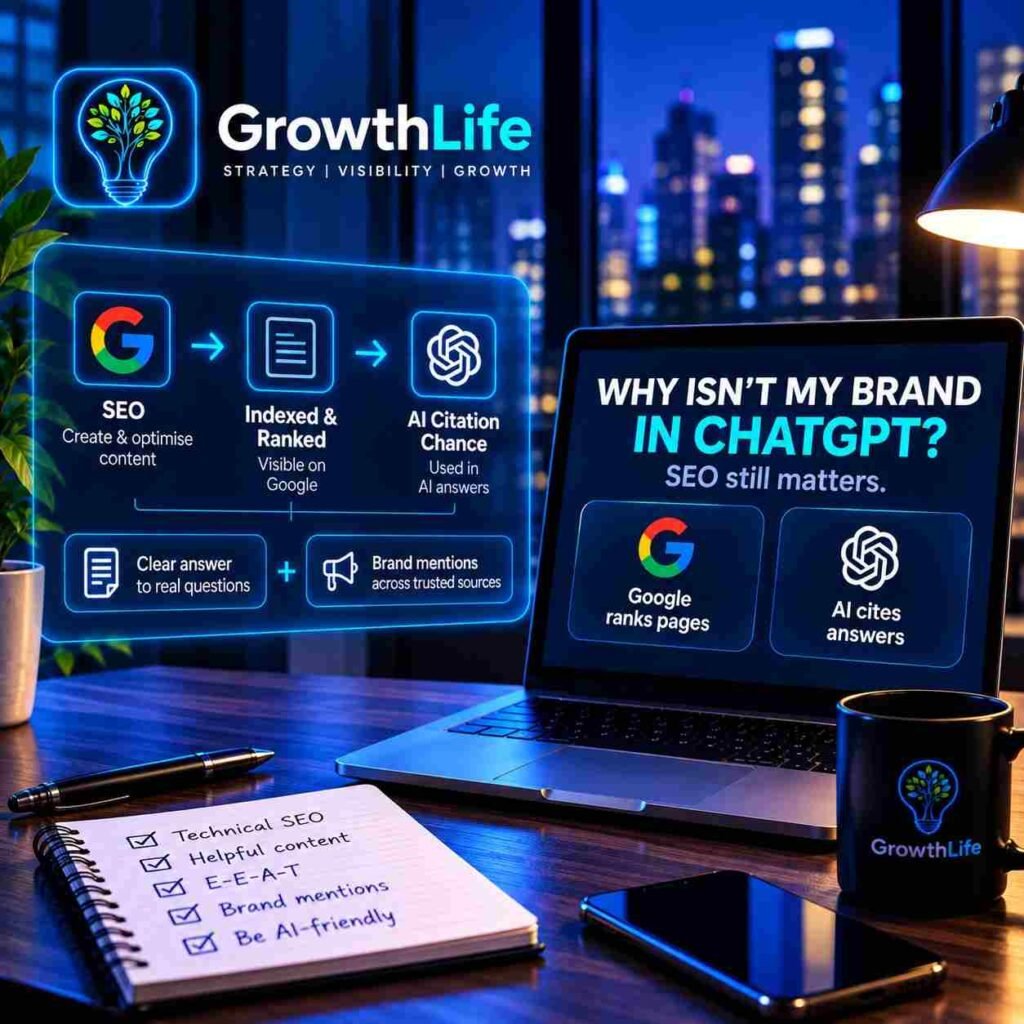
Three separate threads asked a version of this on r/SEO in the last 36 hours, and two of them were removed by mods with zero answers. So here is the long answer, with the trade-offs left in. Most of what gets sold as “GEO” right now is repackaged on-page SEO, but the part that is genuinely new is real, and it is measurable.
Quick answer if you’re skimming
- Google ranks pages. AI models quote paragraphs. You can win one and lose the other, and that is the whole problem.
- The single highest-leverage change is one plain sentence directly under each heading that still makes sense when it is lifted with no context around it.
- Skip llms.txt. Nobody on the threads reports it doing anything.
- Being the biggest seller in your category does not make you the recommended one. These are different numbers and the gap is widening.
- Do not cut SEO. The pages that get cited by models are mostly pages that already rank and are already indexed.
Why do I rank fine on Google but never get mentioned by ChatGPT?
- Because they are judging different units. As one commenter put it bluntly: “google ranks pages not paragraphs. AI citation is about the quality of a specific answer. Google ranking is about the trust of the whole domain.”
- A page can rank at position 3 on a long, well-optimised guide and still be useless to a model, because there is no self-contained sentence in it worth lifting.
- Models also check you elsewhere before trusting you. The most-upvoted mechanical answer on the threads: “LLMs do not take your word for it. They will look around the web to confirm your authority and trustworthiness.”
- For an Indian business that means your Google Business Profile, your marketplace listings and any third-party roundups you appear in are doing work you are not measuring.
- Schema helps a page that already ranks. It does not rescue one that does not. “Schema won’t save a page that doesn’t rank or get indexed.”
My impressions are up but clicks are flat. Is that an AI problem or a me problem?
- Usually it is both, and you can separate them. Flat clicks with rising impressions on informational queries is the AI Overview pattern. Flat clicks on commercial queries is normally a title, intent or SERP-feature problem and has nothing to do with AI.
- Split your Search Console data by query type before you blame anything. If your “how to / what is / best way to” queries lost CTR and your “buy / price / near me” queries held, that is the answer.
- There is a real attribution blind spot here and it is worth knowing about: AI Overview clicks are not broken out, they land inside normal organic. One commenter’s complaint, verbatim: “It’d be nice of Google AI Overviews clicks were clear in referral data instead of grouped in with all organic traffic.”
- You will see a claim going around that “AI is now like 70% of online searches with most results not leading to external clicks.” Treat that as a Reddit number, not a fact. I could not verify it and it looks inflated. Do not put it in a client deck.
- One person did report a real, measured uplift: “Up 5X this month in ChatGPT referral traffic in GA4 with revenue starting to come in.” Self-reported, single account, but it is at least a number from someone’s own GA4 rather than a vendor slide.
What actually makes a paragraph get quoted?
- Answer first, evidence second. The pattern that keeps getting upvoted: “LLMs like deep, focused content, with the answer first, followed by supporting evidence. Make it hard to summarize but easy to quote.”
- Write one or two plain sentences directly under each H2 that survive being lifted alone. That means no “as mentioned above”, no “this”, no pronouns pointing back at the previous paragraph.
- Break the page into clearly separated sections with real subheads. The term people use is chunked content, and it is just good structure with a new name.
- A big FAQ block bolted onto the bottom of the page mostly does not get pulled. If a question matters, give it its own section in the body.
- Specificity is what gets credited. “Generic stuff gets paraphrased with no credit, specific claims tied to something only you have get cited.”
Do I need an llms.txt file?
- This is the clearest consensus I found and it is worth saying plainly because agencies are currently selling it.
- Verbatim from the thread: “those overhyped llms.txt files don’t hurt, but at present, they don’t help at all. Unless you have time to spare, you can skip them.” A second commenter: “feels like a lot of hype for zero payoff rn.”
- If someone is charging you a line item for llms.txt implementation, that is a reasonable thing to query.
- Spend the same hour rewriting the first paragraph under your three most important headings instead.
Does being the biggest seller make me the recommended one?
- No, and there is now Indian data on this worth looking at. A founder on r/indianstartups posted a sunscreen category analysis this week. Everything below is that poster’s own measurement and I could not independently verify it, so treat it as a well-constructed hypothesis rather than a published study.
- They ran 10 buyer questions through 5 fresh logged-out ChatGPT sessions. Re’equil and Minimalist together hold 12.7% of category shelf revenue but were named in 64% and 60% of answers. Dot & Key, the actual revenue leader at 9.1%, was named in 24%.
- Their line about it: “Being the biggest seller does not make you the recommended one. That gap is next year’s revenue.”
- The detail most relevant to anyone with a website: brand-owned pages were the second largest source the model cited. Your own site is doing more of this work than your marketplace listings are.
- The same post has a useful warning about category-level reporting. The category total moved only 1.3% while individual brands moved enormously underneath it: Re’equil ₹12.9 cr to ₹9.0 cr, Vaseline ₹3.7 cr to ₹1.5 cr, while Reginald Men went ₹4.8 cr to ₹9.6 cr and Aqualogica ₹3.3 cr to ₹5.0 cr. A flat category number tells you nothing.
I lost a listing’s visibility overnight. Where do I even start?
- Check price first, before you touch anything else. In the same analysis, one 20g sunscreen gel SKU selling 20,000 units a month at ₹150 fell off the first three pages of four searches in September while still live and in stock. Its price had moved to ₹327. That listing was ₹3.6 crore a year.
- Check whether you were price-matching a promotion that had already ended. NIVEA in that dataset went from a 52% discount to 8%. If you matched 52% and stayed there, you were matching something that no longer existed.
- Compare your discount behaviour to the segment, not to yourself. Multinationals in that sample deepened median discount from 26.5% to 35% and still fell in sales rank on 6 of 8 products. Indian D2C brands held discount flat at 15% and rose on 9 of 13.
- Then check indexation and the title. In that order. It is almost never the exotic thing first.
Should I cut SEO spend and move it to “AI optimisation”?
- No, and anyone selling you that as a clean swap is selling you a rename. The pages models cite are overwhelmingly pages that are indexed and ranking already.
- What has changed is what you report on. The 39-comment thread on this converged hard on one point: “Conversions. Rankings are nice until the client asks where the money is.”
- The honest framing from that thread: “a lot of searches now end in an AI overview or a chatbot reply, so clicks drop even when rankings hold. clients who get cited in those answers keep showing up, even if traffic numbers look flat.”
- The durable moat is content a model cannot paraphrase from someone else: your own numbers, your own case data, your own named brand. Three separate commenters landed on this independently.
- There is a cheap Indian tactic in the threads worth stealing. One agency started posting founder-face reels naming the brand a few times, people then googled the brand by name and landed on the site. As they put it: “we gave them the keywords to look up, so to speak.” Branded search is the one query type AI summaries do not intercept.
How do I check any of this without buying a tool?
- Open five fresh logged-out sessions and ask the ten questions your buyers actually ask. Write down who gets named and how often. That is a real baseline and it costs you an hour.
- Repeat it monthly on the same ten questions. The trend is the useful part, not any single run.
- In GA4, build a segment for referrals from the AI assistants and watch it as a cohort rather than a vanity number.
- In Search Console, split informational from commercial queries and track CTR separately for each. This is the single report that tells you whether to panic.
- If you want someone else to run the first pass, GrowthLife does a free website audit at growthlife.in/quick-audit which will at least tell you whether the indexation and structure basics are in place before you spend on anything fancier.
|
Google ranking |
Being cited by an AI model |
|
|
What’s judged |
The whole page and domain |
One paragraph |
|
What wins it |
Links, authority, intent match |
A clear, self-contained answer |
|
Where FAQs help |
Can earn rich results |
Mostly ignored at page bottom |
|
Does schema fix it |
Helps a ranking page |
Won’t rescue an unranked one |
|
How you measure |
Position, CTR, impressions |
Share of answers across repeated prompts |
|
Time to move |
Weeks to months |
Can shift within a recrawl |
What I’d actually do
- Rewrite the first two sentences under your top five headings so each one answers the heading and survives being quoted with nothing around it. This is a two-hour job and it is the highest-return thing on the list.
- Build your ten-question prompt set, run it logged out once a month, and put that in the client report next to rankings. It takes an hour and it is the only number that currently answers “why aren’t we in ChatGPT”.
- Leave llms.txt alone and put the time into one piece of content built on data only you have.