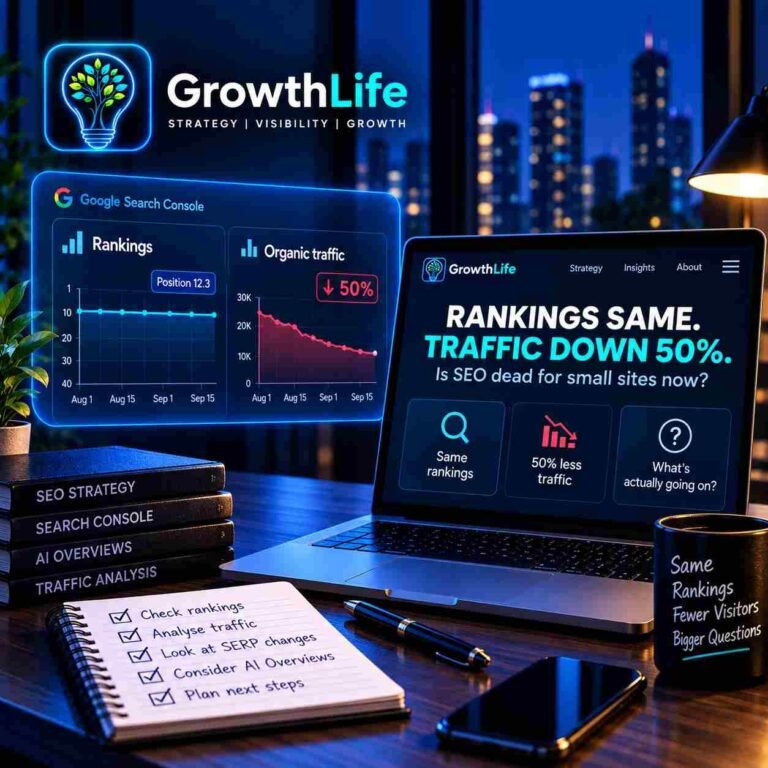
My Google rankings haven’t moved but my traffic is down. What’s actually going on?
 GrowthLife
25 Sep 2026
6 min read
GrowthLife
25 Sep 2026
6 min read

Your position tracker looks fine and your analytics looks terrible. That combination has a specific cause, and it is not a penalty. Here is what changed, what the numbers actually say, and which of your reports is now lying to you.
Quick answer if you’re skimming
- When Google shows an AI summary, people click a normal result about 8% of the time instead of 15%. Your ranking did not move; the clicks moved.
- They almost never click links inside the summary either — roughly 1% of visits.
- Traffic from AI chatbots is real but still tiny. One study of 94 e-commerce sites found non-branded organic was about 70x larger than ChatGPT traffic.
- But that small AI traffic converted better: 1.81% vs 1.39%. Sessions are a worse business metric than they used to be.
- Stop reporting sessions to yourself. Report revenue per session and branded search volume.
Is this actually happening, or am I imagining it?
- Pew Research tracked 68,879 real searches by 900 US adults and found users clicked a traditional result on 8% of visits where an AI summary appeared, against 15% where none did.
- They clicked a link inside the AI summary on 1% of visits.
- 26% of sessions ended entirely on a page with an AI summary, against 16% without one.
- AI summaries appeared on 18% of all searches in that sample, and 88% of those cited three or more sources.
- Caveat worth stating plainly: this is US data collected in March 2025. It is the best public measurement available, but it is neither Indian nor current. Treat the direction as solid and the exact figures as dated.
So is SEO dead?
- No, and the people saying so are usually selling the replacement.
- Ahrefs looked at roughly 35,000 sites and found Google still sent about 345 times more traffic than ChatGPT, Perplexity and Gemini combined.
- AI tools accounted for about 0.1% of total referral traffic in that dataset.
- That study is from March 2025 and almost certainly understates today’s share. It does not understate it by 345x.
- What actually died is the assumption that a ranking converts into a visit at a fixed rate. That rate dropped. The ranking still matters, because the summary is assembled from pages that rank.
My traffic fell. Did my revenue fall?
- Often not by nearly as much, and this is the single most useful thing to check before you panic or fire anyone.
- Visibility Labs analysed GA4 data across 94 e-commerce sites for all of 2025: ChatGPT referral traffic converted at 1.81% against 1.39% for non-branded organic, about 31% higher.
- Average order value went the other way: $204 from ChatGPT against $238 from organic, down about 14%.
- Net revenue per session still came out ahead: $3.65 against $3.30.
- The honest framing: you are losing a lot of low-intent sessions and keeping most of the high-intent ones. A 40% traffic drop with a 5% revenue drop is a very different emergency from a 40% revenue drop.
How big is this in India specifically?
- Smaller than the discourse suggests. In the Ahrefs data India received 4.9% of AI traffic against 7.71% for the US.
- Scale matters more than share: in that same e-commerce dataset ChatGPT accounted for 1.48% of organic revenue across the year, rising to about 2.2% in the second half.
- Rising fast from a small base is still a small base. Budget accordingly.
- If you sell to Indian consumers, the bigger 2026 story is probably not AI search at all — it is that D2C order volume grew 34% while GMV grew 33%, meaning growth is coming from more orders, not higher prices.
- Tier 2 and Tier 3 cities produced 66% of incremental order volume in that Unicommerce dataset of 6,000+ brands and 410 million shipments.
What should I measure instead of sessions?
- Revenue per session, tracked monthly. If sessions fall and this rises, you are fine.
- Branded search volume. When people meet you inside an AI answer and then search your name, this is where it shows up — and it will look like “direct” traffic.
- Assisted conversions, not last-click. AI referrals are badly attributed by default.
- Share of the queries that actually matter, not total keyword count.
- 90-day repeat purchase rate. The Unicommerce analysis called brands under 20% here “structurally running at a loss” — and no amount of traffic work fixes that.
How do I actually get cited in AI answers?
- Rank first. Summaries are assembled from pages that already rank; there is no separate back door.
- Answer the question in the first two sentences of the section, in plain language, before the context. Extraction rewards the direct answer.
- Use real numbers, dates and named sources. Vague pages do not get quoted because there is nothing quotable in them.
- Structure with genuine question headings that match how people ask, rather than keyword headings.
- Worth knowing: Wikipedia, YouTube and Reddit together made up about 15% of sources cited in AI summaries in the Pew sample. Being discussed in those places is itself a visibility channel.
What’s a waste of time right now?
- Rewriting your whole site for “AI optimisation”. It is the same work as good SEO with a new invoice attached.
- Paying for a tool to track your ChatGPT rankings when ChatGPT is 1.5% of your revenue. Measure it, do not build a department around it.
- Chasing keywords whose answer fits in one sentence. Those are gone and they are not coming back.
- Applying US benchmarks to Indian ad campaigns. Indian Meta CPMs generally sit in the $1.50–$5 range, and one Indian agency notes clients using US numbers over-budget by two to three times.
Should I hire an agency for this?
- Only after you have checked revenue per session yourself. It takes twenty minutes in GA4 and it decides whether you have a problem at all.
- If revenue held steady, you need better reporting, not a retainer.
- If revenue genuinely fell, get someone to audit which specific pages lost clicks and whether those pages ever produced revenue.
- Ask any agency to show you revenue per session, not a traffic graph. An agency that leads with sessions in 2026 is either behind or hoping you are.
- Full disclosure since it is relevant: I work with GrowthLife, which does this kind of work and runs a free website audit. You do not need us to run the GA4 check above, and you should run it before you talk to anybody.
Source | Conversion rate | AOV | Revenue per session | Relative volume |
Non-branded organic | 1.39% | $238 | $3.30 | ~70x larger |
ChatGPT referral | 1.81% | $204 | $3.65 | baseline |
Visibility Labs / Search Engine Land, 94 e-commerce sites, GA4, Jan–Dec 2025. Volume gap narrowed to about 47x by Q4 2025.
What I’d actually do
- Open GA4 today and compare revenue per session for the last 90 days against the same period last year. That number, not your traffic graph, tells you whether anything is actually wrong.
- Pull the ten pages that lost the most clicks and check how much revenue each one ever produced. Most of the time the biggest losers were never earning anything.
Change your monthly report to lead with revenue per session and branded search volume, and keep sessions as a secondary line. You will stop having this panic every quarter.