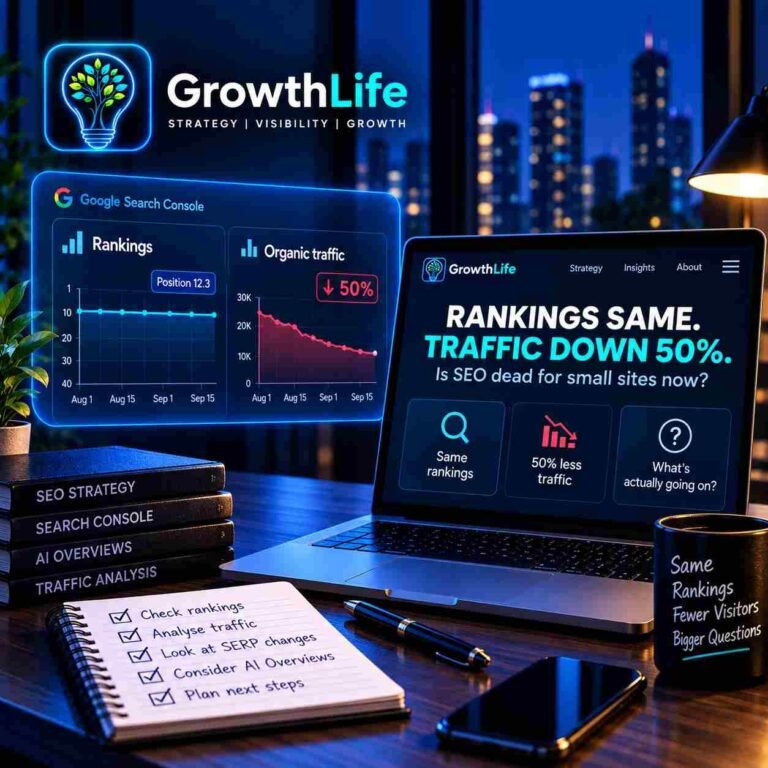
Organic traffic is down and AI is answering everything. Do I move the budget to ads or fix the site?
 GrowthLife
29 Sep 2026
9 min read
GrowthLife
29 Sep 2026
9 min read
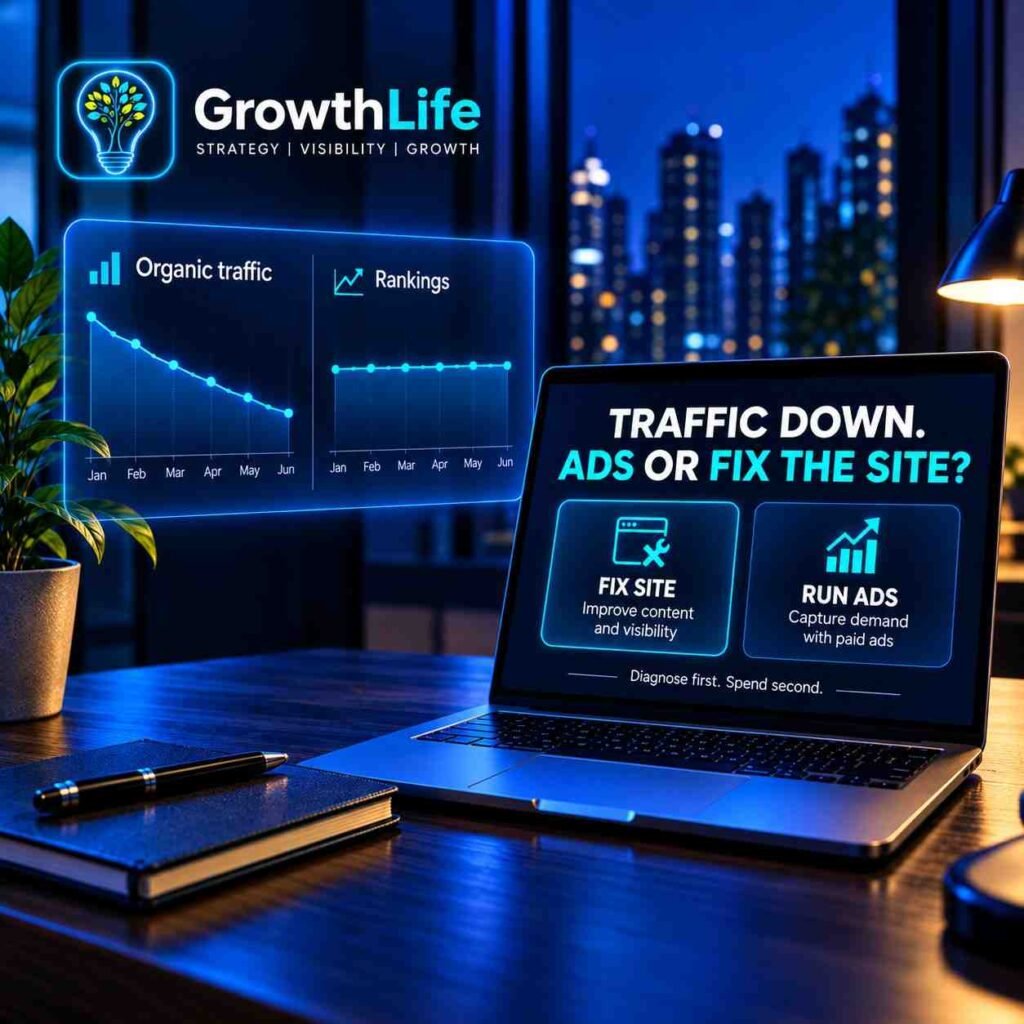
Organic clicks have been falling all year and the usual advice has stopped working. This is what the data actually shows, and how to tell an AI problem apart from one you caused yourself.
Quick answer if you’re skimming
- Some of your drop is real and structural. A randomised field experiment run in January and February this year, an SSRN preprint not yet peer reviewed, found AI Overviews cut organic clicks by 38%, and zero-click searches rose from 54% to 72% when an overview appeared.
- Some of it is not AI at all. Google shipped a spam update on 24 September 2026 with a two-week rollout, so it may still have been landing on your site after you noticed the drop. Check your dates before you blame the robots.
- Getting cited by an AI answer and getting recommended by one are different things, and the gap between them is large.
- Before moving budget to paid, split brand from non-brand in your reporting. Most “ads are working” and “ads stopped working” stories are just brand spend moving around.
- The single highest-value change is boring: write pages that can be quoted one paragraph at a time.
How much of my drop is actually AI, and how much is something else?
- Google shipped its September 2026 spam update on 24 September, and said it could take up to two weeks to roll out fully. The March, June and August updates finished in one, two and three days respectively, so this one is unusually slow. If your wobble started that week, that is a candidate.
- Chartbeat’s 2026 publisher data shows Google Search referrals down 2% year on year to July 2026, and Discover down 34.3%. The year before, those figures were 21.9% and 6.6%. Search roughly doubled its rate of decline; Discover’s was more than five times the previous year’s.
- Caveat on that one: it is a news and publisher-heavy network, and the report does not make clear whether it is measuring absolute pageviews or share. Treat it as direction, not as your number.
- Ahrefs measured position-one CTR on keywords with an AI Overview falling 5% between March 2024 and March 2025. That is a relative fall on an already small base, so do not read it as “we lost a third of our traffic”.
- A separate randomised experiment from UPenn and Northeastern found that removing AI Overviews increased clicks without reducing user satisfaction, and that users pushed into AI Mode trusted it less and switched to Bing or DuckDuckGo more.
- Do the boring check first. Compare branded and non-branded queries separately in Search Console. If branded impressions are flat and non-branded informational queries fell off a cliff, that is AI. If everything fell together, look at your own site.
Is “optimise for citations instead of rankings” actually a real strategy?
- The change people describe is concrete and not very glamorous. One commenter put it as well as anyone”
- Another added the diagnostic: Google will happily rank a page where the actual answer is buried three paragraphs down behind an intro. A model will not lift that paragraph, because out of context it means nothing.
- Practically: put the answer in the first line under the heading. Name the thing. Give the number, the date and the unit plainly. Stop writing “as we discussed above”.
- This costs you nothing and improves the page for humans too, which is why it is the one recommendation here with no downside.
If I get cited, does that mean I get recommended?
- Not reliably, and this is the most interesting disagreement in the threads right now.
- One commenter ran 291 test prompts across 13 brands and found being named without being cited happened essentially never. So citation works as a gate. But past that gate it collapses: the chance of being named given you were cited ranged from 49% down to zero, and three brands were cited between 48 and 90 times and never named once.
- Their conclusion, verbatim: “So citation is the gate rather than a vanity metric. Nobody gets recommended without being retrieved… Rankings feed the first step and tell you almost nothing about the second.”
- The direct counter, in the same thread: “Why would you optimise for citations? Citations itself are a vanity metric that tells you only that your content was used. You want to be mentioned, you want to be recommended for things that make you money.”
- A third position, worth hearing: optimise for neither, optimise for sales-intent queries, because informational citations do not produce revenue regardless.
- All three are defensible. The honest summary is that citation is necessary and not sufficient, and nobody has published a reliable method for the second step yet.
What you are measuring | What it tells you | What it does not tell you |
Google ranking | You are eligible to be retrieved | Whether any model actually pulls you |
AI citation | A model pulled your page as a source | Whether it recommended you to the user |
AI recommendation | You were named as an answer | Whether that user was ever going to buy |
Revenue from the query | The only thing that pays salaries | Very little, until you instrument it |
How do I check what AI says about my brand right now, without paying for a tool?
- Open ChatGPT and Perplexity. Type the query your customer would type. See which page gets cited.
- It is very often not the page ranking first in Google. Go read that page and ask what it does differently, above all how early in the page the actual answer appears.
- Then run your own brand name, plus “alternatives to [your brand]”, plus “[your category] in India”. Write down anything wrong.
- Do this for ten queries and you will have a better picture than most paid dashboards will give you in month one.
- Repeat it monthly, not daily. Answers vary run to run, so a single bad result is noise.
AI is saying something wrong about my brand. How do I fix that?
- The advice that came up repeatedly is to corroborate, not to counter-attack. One version, verbatim: “Put each fact it gets wrong on your own site as a plain, checkable statement with specs, dates and a source. Then get those same facts said somewhere you don’t own: distributor pages, reviews, trade press. Right now only one side of the story has any backup, so that’s the side the model repeats.”
- Off-site matters more than on-site here. A claim only you make is a claim. A claim your distributor, a review site and a trade publication also make is a fact as far as retrieval is concerned.
- Vertical directories for your category are underrated for this, because they are structured, crawled and stable.
- Be careful with listicle placements. If the listicle repeats the same wrong information, a good placement actively hurts you.
- If a competitor’s comparison page is the source of the error, a polite correction email is cheaper than anything else on this list.
Should I just move the budget into Google Ads instead?
- Maybe, but check five things first, because most brands that “moved to paid” actually just moved money onto their own brand name and then congratulated themselves.
- Split brand and non-brand in every report. They behave completely differently and averaging them hides everything.
- Run a brand holdout before you increase brand spend. Pause brand in one region, or for two weeks, and see what actually changes.
- Judge on CRM outcomes through offline conversion imports, not on clicks. As one commenter put it, “The accounts that look like they’re struggling are usually the ones still judging on CTR or CPC instead of cost per sale.”
- Add a free-text “how did you hear about us?” field to every form. AI-influenced buyers arrive in your analytics as direct or as brand search, so this is often the only place they show up honestly.
- Read the search terms report weekly. People arriving from a chat interface type longer, more specific queries than they used to.
What is happening to paid costs while all this goes on?
- An Optmyzr employee in one of the threads described rising CPCs and falling volume as consistent across industries, with conversion rates rising enough that most accounts come out roughly flat on cost per sale. That is a practitioner’s read from their data, not a figure I could verify, so treat it as informed opinion.
- There is a newer, nastier failure mode on brand terms. Same commenter: “brand is getting weirder too with ai max/pmax going nuts. they heavily index on competitor terms (aka your brand terms) so if someone else on the serp starts testing it…. they’re accidentally bidding on your brand terms with non-brand bids.”
- For context on where the Indian money is going: Dentsu put Indian digital ad spend at ₹71,621 crore in 2025, up 19%, at 59% of total adex, and projected 70% share by 2027. E-retail media was the fastest-growing line at ₹17,601 crore, up 55.86%.
- So the competition for paid inventory is getting worse at the same time as organic gets thinner. Moving budget from one to the other is not a strategy on its own.
I’m a small Indian D2C brand. Is an agency worth it for this?
- I work at one, so discount this accordingly.
- I am not going to quote you an Indian retainer range, because every figure I could find for Indian agency pricing was on an agency’s own lead-generation blog with no methodology behind it. Ask three agencies directly and you will learn more than any published range will tell you.
- What the threads consistently say is worth more than the price question. The highest-voted reply to a pricing thread was: “I’d be more interested in what these 20 hours will yield than the price tag… ask them: What do they plan to actually be doing for 90 days, how many pages they will be publishing, what type of links they are creating.”
- The cautionary tale from the same thread is the standard one: “I had a client that was paying $3k/mo for SEO services for 6 months and I pulled his site up on Ahrefs and they had done nothing to improve his ranking except flood it with low quality spammy backlinks.”
- The work described in this article, entity and fact scaffolding, off-site corroboration, holdout tests, offline conversion imports, is agency-shaped work because it is slow and unglamorous, not because it is difficult. A competent in-house person can do all of it.
- If you do hire, ask for the 90-day plan in writing before you sign, and ask what they will stop doing if it does not work.
What I’d actually do
- Spend this week separating brand from non-brand in your reporting and running a brand holdout. Almost nobody does this and it changes what every other number means.
- Pick your ten highest-intent pages and rewrite each so the answer sits in the first line under each heading, with the number, the date and the unit stated plainly. Then re-check in ChatGPT and Perplexity in thirty days.
- Fix whatever is stopping crawlers reaching your site before you spend a rupee on content. A page nothing can fetch cannot be ranked, cited or recommended, and this is more common than people think.