Is SEO still worth paying for in 2026, or is AI search eating all the clicks?
 GrowthLife
2 Oct 2026
7 min read
GrowthLife
2 Oct 2026
7 min read
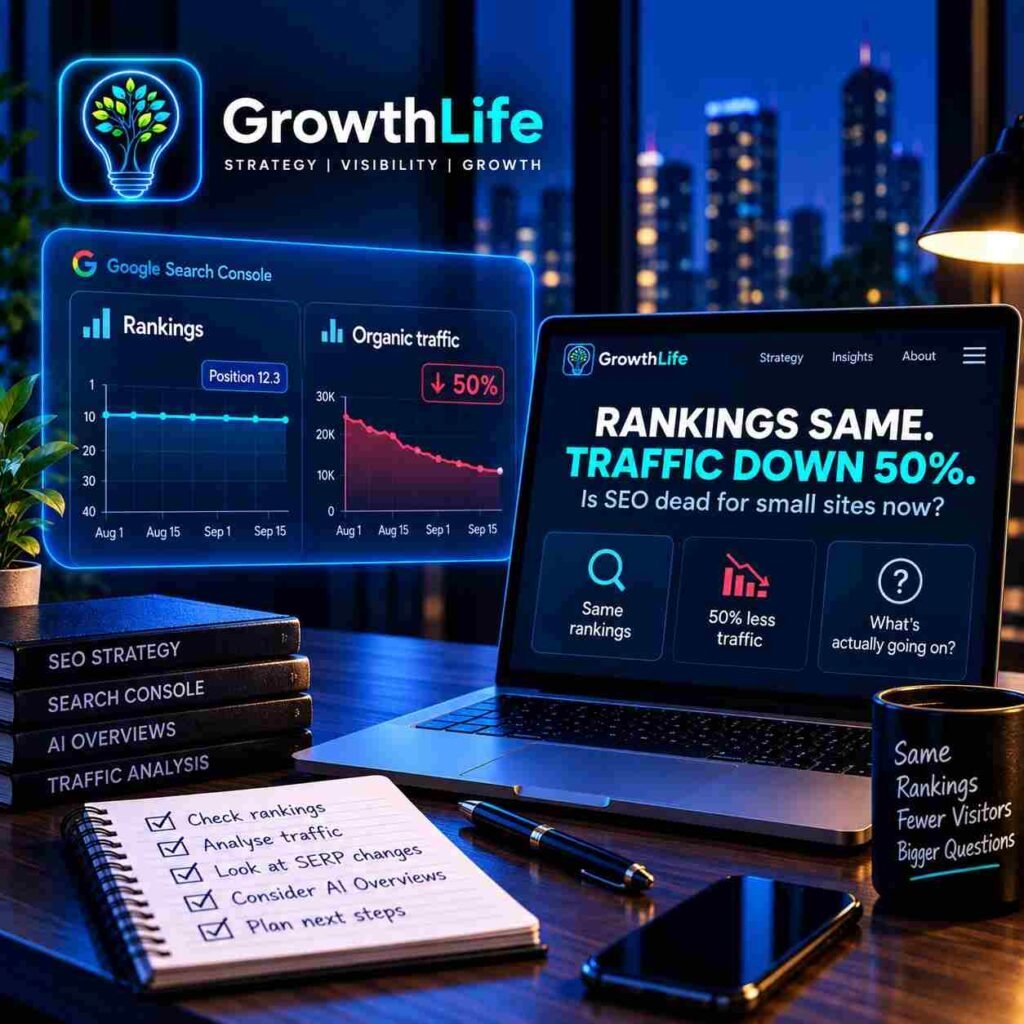
Every week someone posts a chart of their organic traffic falling off a cliff and asks whether SEO is finished. The honest answer has three parts: the click loss is real but smaller than the panic suggests, a lot of what looks like AI is actually an algorithm update, and the thing most Indian founders are paying for was never SEO to begin with.
Here is what the actual numbers say, what it costs in rupees, and what to buy instead.
Quick answer if you’re skimming
- AI summaries do cut clicks roughly in half when they appear — but in the one large tracked study, they appeared on about 18% of searches, not most of them.
- If your traffic fell off a cliff in the last ten days, suspect the September 2026 Google spam update (rollout began 24 September) before you blame AI.
- Paid search is only about 23% of Indian digital ad money. Social and video are each bigger. Search was never the whole game here.
- Median Google Search CPC in India sits near ₹18; Meta CPM near ₹290. That is your real benchmark for whether organic is worth the wait.
- “10 blogs a month” is the thing to stop buying. Pages tied to something only you have — your pricing, your data, your process — are what still get cited.
Is SEO actually dead?
- No, but the thing being sold as SEO largely is. Volume content was commoditised the moment everyone got the same generation tools.
- The best-voted answer in the r/digital_marketing thread this week put it better than any vendor blog: “Original data, real experience, or an actual opinion is what separates you now, since anyone can generate content at scale. Generic stuff gets paraphrased with no credit, specific claims tied to something only you have get cited.”
- What died is the arbitrage — writing a competent summary of a topic and ranking for it. What survived is being the primary source.
- For an Indian D2C or services business, the pages that still earn their keep are pricing, comparison, “how this works for India specifically”, and real case numbers.
How much are AI answers really costing in clicks?
- The only large tracked dataset anyone should be quoting is Pew Research’s, from March 2025: 68,879 searches by 900 US adults.
- About 18% of those searches produced an AI summary — roughly one in five, not “most searches”.
- When a summary appeared, users clicked a traditional result on 8% of visits. Without one, 15%. So roughly half the clicks, on that fifth of searches.
- Only 1% clicked a link inside the AI summary itself. Being cited in the summary is brand exposure, not traffic.
- Sessions ended entirely on 26% of pages with a summary versus 16%
- Caveat that matters: that is US data from 2025 and 900 people. Anyone quoting “70% of searches are AI now” is making it up — I went looking for the source and there isn’t one.
My traffic dropped suddenly. Is that AI or an update?
- A cliff in a single day is almost never AI. AI erosion is a slope over months.
- Google’s September 2026 spam update started rolling out on 24 September, globally and across all languages, with a stated rollout window of up to two weeks. If your drop sits inside that, start there.
- There is a live case on r/SEO this week: an independent events aggregator reporting roughly 95% of Google Search traffic gone overnight from 27 September, cross-checked in both Search Console and PostHog, with clean technicals — open robots.txt, self-referencing canonicals, no noindex, sitemap present. One person’s report, not a finding, but the timing is the point.
- Diagnostic order that actually works: Search Console impressions versus clicks first (impressions holding while clicks fall is an AI or SERP-layout story; both falling is a ranking story), then compare against the update dates, then check server logs for bot behaviour, and only then rewrite anything.
What does organic versus paid actually cost in India right now?
- India’s total ad spend in 2025 was ₹1,21,339 crore, up 8.3%. Digital was ₹71,621 crore of that — up 19% year on year and 59% of all ad money, heading for about 70% by 2027 (Dentsu).
- Inside digital, the split is the useful part: social ₹21,057 cr (29%), online video ₹20,004 cr (28%), paid search ₹16,581 cr (23%), display ₹11,581 cr (16%).
- Read that again before you spend six months on search: in India, search is under a quarter of digital spend. It is not where most intent gets captured.
- On unit costs, one 2026 dataset covering more than 100 Indian D2C brands and over ₹8 crore of managed spend puts the median Google Search CPC at ₹18 and Meta CPM at ₹290. The dataset’s owner isn’t named in the coverage, so treat it as an order-of-magnitude anchor, not gospel.
|
Channel |
What it costs you in India |
What it is actually good for |
How long before you know |
|
Google Search ads |
~₹18 median CPC |
Existing demand, high intent, bottom of funnel |
2–4 weeks |
|
Meta ads |
~₹290 CPM |
Creating demand, retargeting, D2C discovery |
2–6 weeks, creative-dependent |
|
Organic search |
Salary or retainer, not media spend |
Compounding, defensible, cheap at scale later |
4–9 months honestly |
|
ChatGPT ads (new) |
₹725/day minimum |
Experimental. Reach is real, measurement isn’t yet |
Unknown — treat as a test budget |
Should I hire an agency, a freelancer, or someone in-house?
- Price anchors from Indian hiring posts this quarter: a community or content associate runs ₹20,000/month at 0–1 years; a content and brand marketing executive ₹30,000–40,000/month at 1–3 years.
- So a ₹60,000/month retainer is two junior salaries. That is the comparison to make, not “retainer versus nothing”.
- In-house wins when the work needs your actual product knowledge and runs forever. Outside help wins when you need a capability you can’t hire for yet, or a one-time build.
- The failure mode is paying outside rates for work that only looks like output. One founder in that thread: “They used AI to generate blog posts and automatically upload them. The content is very rich and the website looks professional, but it hasn’t brought me any customers at all—and I still have to pay them expensive fees.”
- Ask one question before signing anything: what will you show me in week six, and what number does it move? If the answer is a content calendar, walk.
What does a fair quote look like in rupees?
- A founder-written breakdown of a typical ₹2 lakh Indian quote for a business website with booking or enquiry: design ₹30,000–40,000, development ₹60,000–80,000 (often subcontracted), project management ₹20,000–30,000, content and images ₹10,000–20,000, testing and launch ₹10,000–15,000, the rest margin.
- The clause that causes every dispute: two revision rounds included. Everything after that is billed, and that is where the relationship goes bad.
- Get the revision count, the definition of a revision, and who owns the hosting and analytics accounts in writing. Account ownership is the one that bites a year later.
- If a quote has no line items, it isn’t a quote.
Is it worth advertising inside AI assistants yet?
- It’s now possible: OpenAI’s self-serve Ads Manager opened in India on 4 September 2026, with a minimum of about ₹725 per day. Ads show on the free tier and the ₹399 “Go” tier only, labelled, below the answer.
- Reach is not the problem — 100 million-plus weekly users in India.
- Pricing is the problem. Pilot CPMs ran near $60, now averaging nearer $45 with some deals at $25–35, against Meta “typically below $20”. You are paying a premium for novelty.
- Reasonable position for a small Indian business: not yet, unless you sell something with a very high order value and you can tolerate an unmeasurable month. The ₹725/day floor is ₹21,750/month to learn something you could learn cheaper on Meta.
What should I actually buy instead of “10 blogs a month”?
- Fix the money pages first. Pricing, the top three service or product pages, and the enquiry flow. Most sites leak here, not in the blog.
- Publish the things only you can publish. Your real numbers, your real process, your actual prices. That is what gets cited now and it is also what closes deals.
- Instrument before you spend. Search Console, GA4 and a session recorder. A founder in these threads burned roughly ₹40,000 on Meta in a month across CBO and ABO campaigns with zero purchases — add-to-carts and abandoned checkouts only, almost all static creative. That is a creative and checkout problem that no amount of ad budget fixes.
- Buy one outcome, not a channel. If someone can’t name the outcome, the retainer is a subscription to activity.
- That packaged-outcome shape is what GrowthLife sells — a “Sales-Ready Business in 30 Days” rather than hours of SEO — and I’d say the same thing if you built it in-house. The unit you buy matters more than who you buy it from.
What I’d actually do
- Spend this week on diagnosis, not strategy: pull Search Console impressions versus clicks for the last 90 days and line the dates up against the 24 September spam update. You will usually find your answer there, and it is free.
- Move the next ₹50,000 away from volume content and into one money page plus one piece of original data only you have. Then measure enquiries, not rankings.
- If you’re buying outside help, buy a named outcome with a date and a number. Ask what week six looks like. A content calendar is not an answer.