What Is Generative Engine Optimization (GEO)? GEO vs SEO Explained
 GrowthLife
1 Nov 2026
6 min read
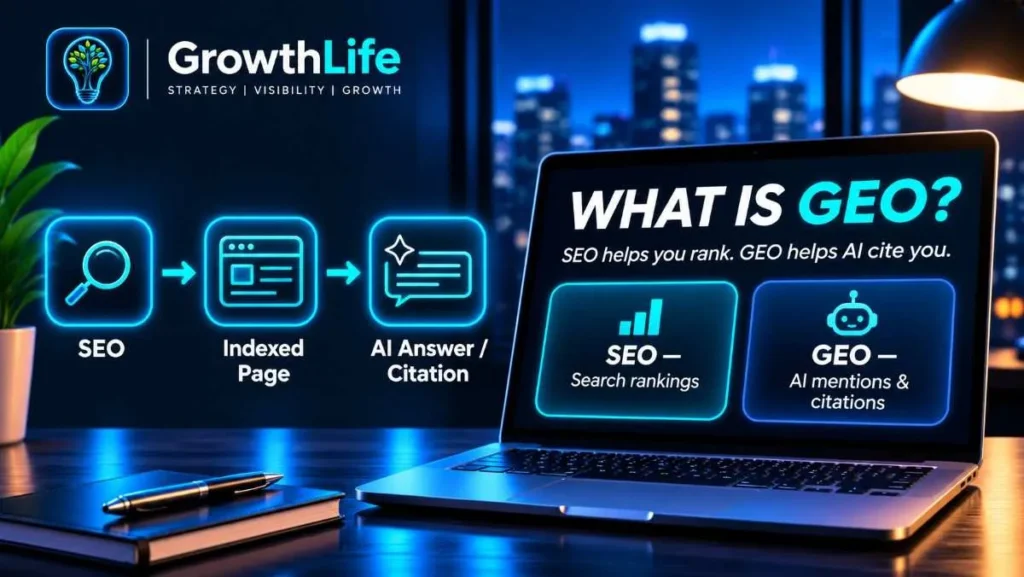
Generative engine optimization (GEO) is the work of making your content easy for AI answer tools to find, understand and cite. These tools include ChatGPT, Google AI Overviews and Perplexity. SEO aims to rank your page in a list of links. GEO aims to get your business named or linked inside the AI-written answer itself.
Quick summary
- What it is: optimising content so AI search tools use and cite it in their answers.
- Where the term comes from: a 2023 research paper titled “GEO: Generative Engine Optimization”.
- Base layer: AI tools still rely on crawled, indexed pages. Good SEO comes first.
- Crawler access: ChatGPT search and Perplexity use their own search crawlers, which you can allow in robots.txt.
- Main habits: answer-first writing, clear facts, consistent business details and real expertise.
What is generative engine optimization?
A generative engine is a search tool that writes an answer instead of only listing links. When someone asks “best CA for GST registration in Pune”, the tool searches the web, reads several pages, and writes a short reply. It often shows links to the pages it used.
GEO is about being one of those pages. The term was introduced in a 2023 research paper on arXiv. The authors described it as a way to help content creators improve their visibility in AI-generated responses. They also found that what works varies by topic.
GEO vs SEO: what is the difference?
GEO does not replace SEO. It builds on it. If you are new to search, start with our guide to what SEO is.
| Point | SEO | GEO |
|---|---|---|
| Goal | Rank your page in search results | Get cited or named inside an AI answer |
| Where results appear | Google and Bing result pages | ChatGPT, Perplexity, Google AI Overviews and AI Mode |
| What the user sees | Your title and snippet | A summary of your content, often with a link |
| Unit of success | Rankings, clicks | Mentions, citations, clicks from AI answers |
| Content style | Keyword-focused pages | Clear, quotable answers and facts |
| Example for a Pune bakery | Rank for “custom cakes Pune” | Be named when someone asks an AI where to order an eggless cake in Pune, with your “from ₹600 per kg” price quoted correctly |
The bakery price above is a sample figure. The point is that AI tools repeat what your page says, so your prices, areas and timings must be stated clearly and kept current.
How do AI answers pick their sources?
No AI company publishes a full formula. But their own documentation explains the basics.
Google AI Overviews and AI Mode
Google says there are no extra requirements to appear in AI Overviews or AI Mode. A page must be indexed and eligible to show in Search with a snippet. Google also says no special AI text files or special schema markup are needed. These features may run several related searches across subtopics, a method Google calls “query fan-out”. That is why they can show a wider set of links than classic results.
ChatGPT search
OpenAI’s documentation says its OAI-SearchBot crawler surfaces websites in ChatGPT search. Sites that block OAI-SearchBot will not be shown in ChatGPT search answers. A separate crawler, GPTBot, is used for model training. You can allow one and block the other.
Perplexity
Perplexity’s documentation says PerplexityBot is used to surface and link websites in its search results, and is not used to train AI models. Perplexity recommends allowing it in robots.txt if you want to appear.
So the common thread is simple. The AI tool must be able to crawl your page, understand it, and trust it enough to quote it.
How to do generative engine optimization: practical steps
- Check crawler access. Open your robots.txt. Make sure Googlebot, OAI-SearchBot and PerplexityBot are not blocked, unless you choose to block them. Check your CDN or firewall settings too.
- Answer first. Put a direct 2 to 3 sentence answer at the top of each page. AI tools often lift short, complete answers.
- Use question headings. Write H2s the way people ask, such as “How much does GST registration cost?”. Then answer right below.
- State facts plainly. Prices, areas served, timings, years in business and service lists should be in text, not only in images or PDFs.
- Keep business details consistent. Your name, address and phone should match across your website, Google Business Profile and listings. Google says to keep Business Profile and Merchant Center details current.
- Show real expertise. Add author names, credentials, original photos and your own worked examples. Avoid copying what every other page says.
- Use structured data honestly. Schema helps search engines read your page, but Google says it must match the visible text. Our schema markup generator can help with the basics.
- Keep pages focused and readable. One topic per page, short paragraphs, lists and tables. Check length with our word counter.
- Update often. Old prices or rules get repeated by AI tools. Review key pages every few months.
How to check if AI tools mention your business
- Ask ChatGPT, Perplexity and Google the questions your customers ask. Note whether you appear and which pages are cited.
- Look at which competitor pages get cited. Study how they structure answers.
- Check referral traffic in your analytics for visits from AI tools.
- Repeat the same questions monthly. AI answers change often, so track trends, not single results.
Common GEO mistakes
- Blocking AI search crawlers by accident: some security plugins and CDN rules block unknown bots.
- Chasing tricks: Google states no special files or markup are needed. Spend the time on content.
- Keyword stuffing: AI tools summarise meaning. Repeated phrases do not help.
- Hiding key facts: prices in images or PDFs are harder for any crawler to use.
If you want help applying this to your site, see our generative engine optimization service and our wider SEO services.
Frequently asked questions
What is generative engine optimization in simple words?
It means preparing your website so AI tools can find it, understand it, and mention it in their answers. Examples are ChatGPT, Perplexity and Google AI Overviews.
Is GEO different from SEO?
Yes, but they overlap. SEO targets rankings in search results. GEO targets mentions inside AI answers. Most GEO work starts with good SEO, because AI tools still rely on crawled and indexed pages.
Do I need special files or code for Google AI Overviews?
No. Google says there are no additional requirements or special optimisations needed. Your page must be indexed and eligible to show with a snippet in Search.
How do I get my website cited by ChatGPT?
Allow OpenAI’s OAI-SearchBot in your robots.txt, as OpenAI says blocked sites will not appear in ChatGPT search answers. Then publish clear, answer-first pages with accurate facts about your business.
How long does GEO take to show results?
There is no fixed timeline. It depends on how often your pages are crawled, your competition, and how strong your content is. Track your AI mentions monthly.