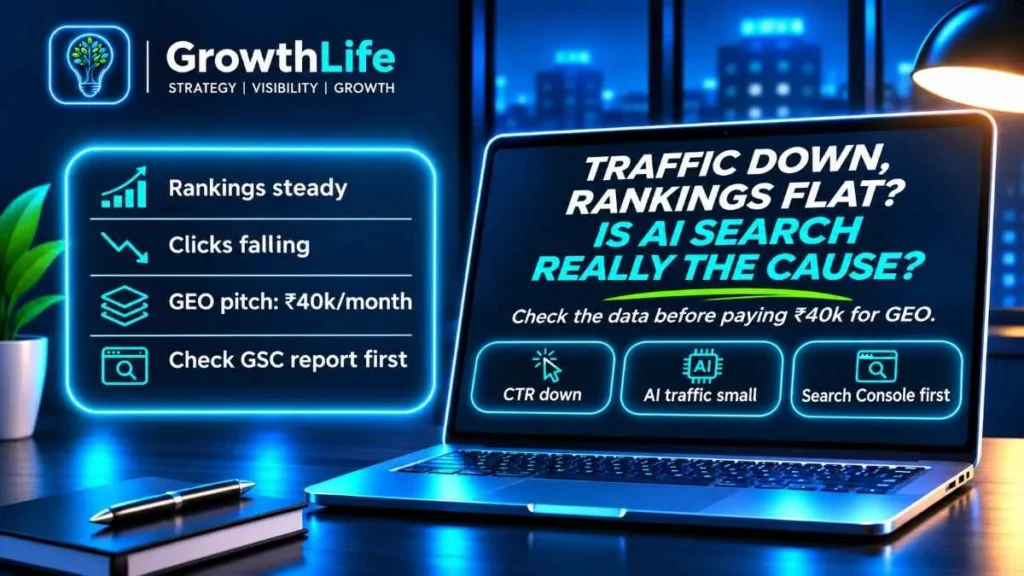
Traffic down, rankings flat, and every agency is pitching me GEO at ₹40k a month. Is AI search really the cause?
 GrowthLife
13 Oct 2026
7 min read
Organic clicks are falling for a lot of Indian D2C and services sites while rankings sit exactly where they were. That gap is real and measurable, and it has produced a wave of “AI visibility” retainers sold on top of it. Here is what the data actually shows, what you can check yourself for free, and what is worth paying for.
Quick answer if you’re skimming
- The click loss is real. With an AI Overview on the page, average CTR for the top-ranking result is about 58% lower (Ahrefs, 300,000 keywords).
- AI referral traffic is not replacing it. AI platforms are a fraction of a percent of web traffic, while organic search is still over 40%.
- Since June 2026 Search Console has a free Search Generative AI performance report. Check that before you pay anyone for an “AI visibility audit”.
- Google’s own documentation says it ignores llms.txt and that you don’t need AI-specific markup. If a pitch deck leads with llms.txt, that is a tell.
- What actually gets you into AI answers is ordinary ranking and crawlability. Buy a ₹2,500–₹9,000/month tool first, buy labour only once you know what is broken.
Is AI search actually why my traffic is down?
- Ahrefs compared 150,000 keywords with an AI Overview against 150,000 without. Average CTR for the top-ranking page was about 58% lower when an AI Overview was present. The effect tapers with position, down to roughly −19% at position 10.
- Pew Research measured real browsing for 900 US adults across 68,879 Google searches. Users shown an AI summary clicked through on 8% of visits, against 15% without one.
- In the same data, sessions ended on 26% of pages with an AI summary, against 16% without.
- So the pattern “rankings unchanged, clicks down” is consistent with AI answers absorbing the click, not with a penalty.
- Caveat worth saying out loud: both those datasets are US-weighted, and most AI-search statistics circulating right now come from companies that sell AI-search tools. Pew and Google’s own docs are the two sources with no product to sell.
How do I check this myself before paying anyone?
- Google added Search Generative AI performance reports to Search Console in June 2026. It shows impressions, pages, countries, devices and dates. It is free and it is in the account you already have.
- Know its two limits before you draw conclusions. It groups AI Overviews and AI Mode together, and clicks are not among the metrics, so you cannot calculate AI-feature CTR from it. Rollout has been to a subset of sites.
- Free AI visibility checks also exist from Ahrefs and HubSpot. Neither is precise, but neither costs anything.
- Pull your own Search Console comparison for the same query set year on year: impressions roughly flat with clicks down is the fingerprint you are looking for.
- This step is the one most ₹40,000-plus “AI audits” are actually sold to perform. Do it first, and you will know whether there is anything to buy.
Is GEO/AEO a real discipline, or SEO with a new name?
- Google’s own AI optimisation guide says it plainly: “optimizing for generative AI search is optimizing for the search experience, and thus still SEO.”
- There is a genuine shift in what wins, which is why the term exists at all: answering the actual question early, cleanly and in a crawlable way matters more than it did.
- What is not new is the mechanism. There is no separate AI index to submit to.
- Google also notes that no third-party tool has access to its internal ranking or AI systems. Any vendor claiming a direct read is overstating.
- Practical test for a pitch: ask what they would do differently if AI search did not exist. If the answer is a short list, it was always SEO.
Do I need llms.txt, AI-specific schema, or content chopped into tiny chunks?
- On llms.txt, Google’s documentation is unambiguous: “Doing so will neither harm nor help your site’s visibility or rankings in Google Search, as Google Search ignores them.”
- Same page: “You don’t need to create new machine readable files, AI text files, markup, or Markdown to appear in Google Search.”
- Also: “You don’t need to write in a specific way just for generative AI search” and “There’s no requirement to break your content into tiny pieces for AI to better understand it.”
- Cyrus Shepard’s May 2026 review scored 23 candidate factors across 54 experiments, patents and case studies. txt scored 2.0, the lowest of all 23.
- None of this means llms.txt is harmful. It means it is not a reason to sign a retainer.
What actually gets content cited in AI answers?
- Top of the same 23-factor review: URL accessibility 9.5, search rank 9.4, query fan-out rank 9.3, preview controls 9.2, query-to-answer match 9.2.
- Bottom: llms.txt 2.0, domain authority 5.0, known-source status 5.4, structured data 5.6.
- Ahrefs found roughly 38% of AI Overview citations come from Google’s top 10 results. Classic ranking is the main door in.
- Preview controls are worth checking today: nosnippet, max-snippet and data-nosnippet can suppress you from AI answers. Plenty of sites set these years ago and forgot.
- So the work that moves AI visibility is crawlability, speed, ranking and answering the question in the first paragraph. That is ordinary SEO, done properly.
What should this cost in India, honestly?
Agency blogs are the only public source for most of these ranges, so treat them as what the market says it charges rather than as survey data.
Option | Typical monthly cost | Worth it when |
Free diagnostics (Search Console, Ahrefs/HubSpot AI checkers) | ₹0 | Always. Start here. |
AI-visibility tracking tool | ~₹2,500–₹9,000 (US$29–99) | You want monthly citation tracking without a retainer |
Freelance SEO | ₹3,000–₹10,000 | You know what needs doing and need hands |
Small agency, SEO only | ₹8,000–₹25,000 | You need process, not strategy |
Mid-size agency, SEO only | ₹25,000–₹75,000 | Competitive category, multiple content streams |
Full multi-channel retainer | ₹75,000–₹2.5 lakh | You genuinely run 2–4 channels at scale |
In-house | ₹40,000–₹1,00,000 salary + ₹25,000–₹30,000 tools | You need daily control and have 12+ months of runway |
- The same market guidance says that below roughly ₹75,000 a month of intended spend, a freelancer serves you better than an agency. For most small D2C brands that makes the honest answer “tool plus freelancer”, not a retainer.
- Where agencies are billed as a percentage of ad spend, published ranges run 15–20% under ₹3 lakh spend, falling to 5–8% above ₹50 lakh.
- If you do want a scoped quote, some agencies, GrowthLife among them, run a free audit before quoting and publish no rate card, pricing on scope instead. Take the free diagnostic and one scoped quote before you sign anything, whoever you talk to.
What should I refuse to sign?
- Citation guarantees. Roughly 40–60% of domains cited by major AI platforms change month to month. Nobody can honestly promise a citation, and before-and-after case studies at that churn rate prove very little.
- A retainer whose main deliverable is a report. If the output is a monthly dashboard, that is a ₹2,500–₹9,000 tool wearing a ₹40,000 invoice.
- Anything priced on llms.txt, AI schema files, or “getting you into ChatGPT’s index”. There is no index to get into.
- Long lock-ins before a diagnostic. Six and twelve-month terms are normal in this market, which is exactly why the free check comes first.
- Vendor-sourced statistics with no sample size. Ask for the n. Ahrefs says 300,000 keywords; Pew says 900 adults and 68,879 searches. Good numbers come with their workings.
If I shift budget to paid ads instead, what’s the GST trap?
- Advertising services carry 18% GST. If Google India or Facebook India bills you, it appears as a line item under forward charge.
- If Google Ireland or Meta Platforms Ireland bills you, it is reverse charge: you self-assess 18% IGST in cash and report it in GSTR-3B Table 3.1(d).
- The trap: reverse-charge liability generally triggers compulsory GST registration regardless of the ₹20 lakh turnover threshold. Small advertisers get caught by this.
- Input tax credit on advertising is available, subject to a valid invoice, the entry appearing in GSTR-2B, and payment within 180 days. Your GSTIN’s state must match the bill-to address or the credit can be lost.
- The 6% equalisation levy on online advertising no longer applies to consideration arising on or after 1 April 2025. That does not remove the GST reverse-charge obligation. Different taxes, different laws.
- Verify your own position with your CA. This is general information, not tax advice.
What I’d actually do
- Open Search Console today, pull the generative AI report and a year-on-year query comparison, and check your nosnippet and max-snippet That is an afternoon and ₹0, and it tells you whether you have a problem worth money.
- If you do, buy a tracking tool at ₹2,500–₹9,000 a month before you buy labour, then brief a freelancer or agency on the specific gaps it shows. Pay for crawlability, speed, ranking and better answers, not for a GEO framework.
- Refuse citation guarantees and refuse any lock-in signed before a diagnostic. If a proposal leads with llms.txt, you have learned what you needed to know about the proposal.