How do you actually know which Meta ad leads became paying customers when everyone calls or WhatsApps you?
 GrowthLife
24 Nov 2026
6 min read
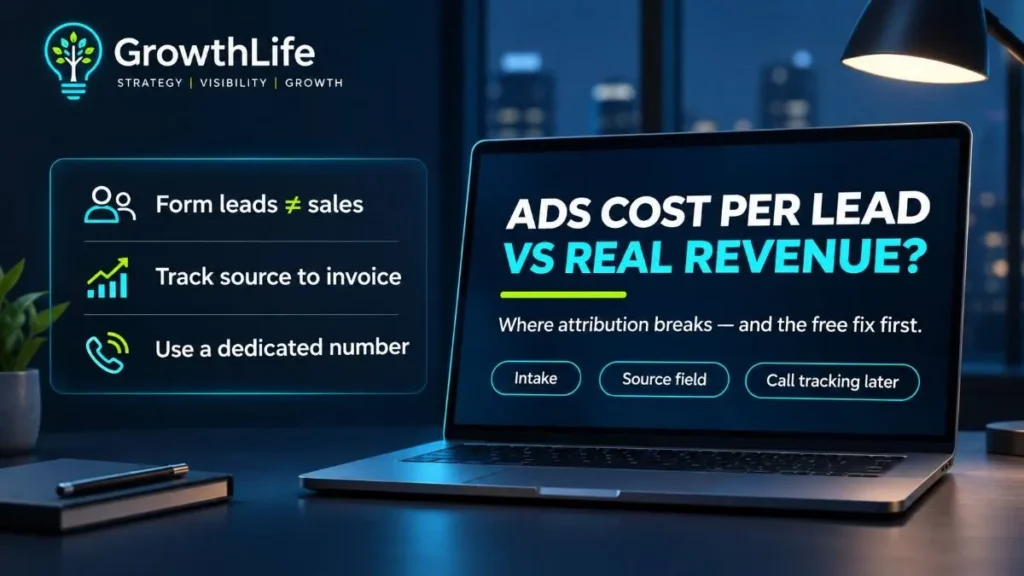
You are spending on ads, Ads Manager shows you a cost per lead, and none of it reconciles with the money that actually landed. This is not a pixel problem and it is almost never fixed by buying software. Here is where it really breaks, what the free fix is, and when paid tracking finally earns its keep.
| Quick answer if you’re skimming Ads Manager’s “cost per lead” is cost per form submission. It is a different unit from a customer, and it does not know whether money arrived. The break is almost never the tracking. It is intake — nobody writes down where the lead came from. Free fix first: one mandatory “how did you hear about us?” field at first contact, carried through to the invoice. Second cheapest: one dedicated phone number on your ad landing page. Separates ads from everything else for the price of a SIM. Paid call tracking only earns its keep past roughly ₹1,00,000/month spend, or when you run many campaigns at once. |

Three places one lead lives — the phone it arrives on, the notebook it gets written into, and the dashboard that never hears about either.
Ads Manager says my cost per lead is ₹180. Why doesn’t that match my sales?
- Because that figure is cost per form submission, not cost per person you can actually bill.
- Meta reports a true cost-per-lead only for lead ads or a custom lead conversion. Other objectives report “cost per result” — so the numbers you are comparing across campaigns are not the same unit.
- Fake numbers, duplicate submissions and people who mistyped a digit all count as results.
- Nothing inside Ads Manager knows whether money arrived in your account.
- The number is not wrong. It is answering a different question from the one you are asking.
Where does attribution actually break?
- At intake, not at tracking. Staff take the call and never record the source.
- Lead source ends up in a spreadsheet filled in from memory at the end of the day, which makes it fiction.
- In India there is a second failure mode: the lead lives in a salesperson’s personal WhatsApp, and personal WhatsApp chats cannot be synced into any system.
- When that person leaves, the pipeline leaves with them.
- Pixel debugging is what gets done because it is visible and technical. Intake is the thing that is broken.
What’s the cheapest fix that actually works?
- Make “how did you hear about us?” a required field at booking or first contact. One field, not five.
- Carry that value onto the invoice, so revenue and source sit in the same row.
- Reconcile weekly — list of paying customers against list of sources. Fifteen minutes on a Friday.
- Put one dedicated phone number on your ad landing page and nowhere else. Any call to it came from ads.
- That is a SIM, a required question and a spreadsheet column. Cost: near enough nothing.

The chain from ad to invoice is usually intact at both ends. It snaps between the phone call and whatever you write the lead down in.
When is it worth paying for call tracking?
- A dedicated number tells you channel, not campaign. Running one to three campaigns, channel is enough.
- Past roughly ₹1,00,000/month spend, or with many simultaneous campaigns, you need dynamic number insertion to tell campaigns apart.
- Tools people actually name, Indian first: TeleCRM around ₹599/month, FreJun around ₹1,149/month, CallHippo around ₹1,300/month. CallRail and CallTrackingMetrics sit around $39–40/month, and CallTrackingMetrics is the one that advertises DNI.
- Those figures came off a vendor’s own comparison page, so treat them as indicative and check current pricing before you buy.
- Do not buy the tool before the required-field habit has stuck. You will pay for it twice.
My conversion tracking was broken for three weeks and I didn’t notice. How do people catch that?
- Watch conversions divided by sessions on a rolling seven-day window. Breaks usually show up as a 30–60% cut, not a drop to zero.
- Alert when yesterday falls below about 30% of the same weekday’s average. Same weekday, because weekends behave differently.
- Count by conversion time, not click time, or attribution lag will hand you false alarms on small accounts.
- When conversions go flat, diff the date against your GTM version history. Drops line up with a publish or a theme deploy with depressing reliability.
- Run Tag Assistant on the thank-you page after every site change and check that a transaction ID actually fires.
- Watch for spikes too. A tag firing twice looks exactly like good news.
Is WhatsApp still the cheap option?
- Not free any more. India template rates run roughly ₹0.86 per marketing message and ₹0.115 per utility message.
- Since October 2026 Meta also charges for service replies and for utility templates sent inside the 24-hour window, with roughly 1,000 free service replies per number per month.
- Rate cards move. Check Meta’s live India rate card before you budget against those numbers.
- The official Cloud API costs money per message. Unofficial QR-code tools are cheaper and carry a real risk of the number being banned.
- So “just use WhatsApp” is now a line item rather than a workaround. Still cheap next to a call centre — just put it in the sheet.
Am I handling GST on ad spend correctly?
- Advertising attracts 18% GST.
- If the invoice is from Google India Private Limited or Facebook India Online Services Private Limited, GST appears as a line and you claim input credit normally.
- If it is from Google Ireland Limited or Meta Platforms Ireland Limited, there is no Indian GSTIN and no GST line. You self-assess 18% IGST under reverse charge, pay it in cash, and claim the credit.
- Billing currency is not the test. The presence of an Indian GSTIN is.
- Reverse-charge liability generally forces GST registration even below the ₹20 lakh turnover threshold.
- This is the item on this list worth raising with your CA today rather than next quarter.
Should I just buy a CRM?
- Not to fix what is a behaviour problem. Indian SMBs end up back on Excel and WhatsApp because the CRM served the manager’s reporting, not the rep’s day.
- What survives contact with reality: lead created from inside the chat, exactly one mandatory field, reminders where people already look, and a single “not followed up today” list.
- Judge adoption at week three, not week one. Anything with five mandatory fields gets abandoned.
- If reps will not fill in one field, they will not fill in fourteen.
- Full disclosure below, but this lead-to-WhatsApp-to-CRM plumbing is what I build for a living — which is exactly why I would tell you not to buy it until the one-field habit has stuck.
What each level of tracking actually buys you
| What you set up | Cost | Tells you | Doesn’t tell you |
| Ads Manager alone | ₹0 | Cost per form submission | Whether anyone paid |
| Required source field + invoice column | ₹0 | Which channel produced revenue | Which campaign or ad |
| One dedicated number on the ad landing page | Cost of a SIM | Ads vs everything else, calls included | Which campaign |
| Dynamic number insertion + CRM | ~₹600–3,000/mo + setup | Campaign and keyword level | Little — this is the practical ceiling |
What I’d actually do
- This week: add one required source field at first contact and one source column on the invoice, then reconcile paying customers against source every Friday. Budget: nothing.
- Put a separate number on the ad landing page and leave it there a month. If ad-attributed calls do not show up, your problem is the offer, not the tracking.
- Only once both are habit, and only past about ₹1 lakh a month in spend, buy call tracking. And ask your CA about reverse charge on Meta Ireland invoices before you spend another rupee on ads.